

This is a NY’26 special edition. For more context, read this:

Drones and autonomy are becoming an ever increasing part of aerospace & defence. So, before looking ahead to what 2026 will look like, let’s revisit 2025. More specifically what I said would happen in 2025 vs. what actually happened.
Here' is what I said a year ago:

Let’s see how I did.
#1 More Drones and Counter-Drones for the Military
My core argument was simple: Ukraine, Middle East, wider conflicts, and China-related tensions would keep defence-related demand for drones and counter-drones high through 2025. That turned out to be correct, and arguably understated.
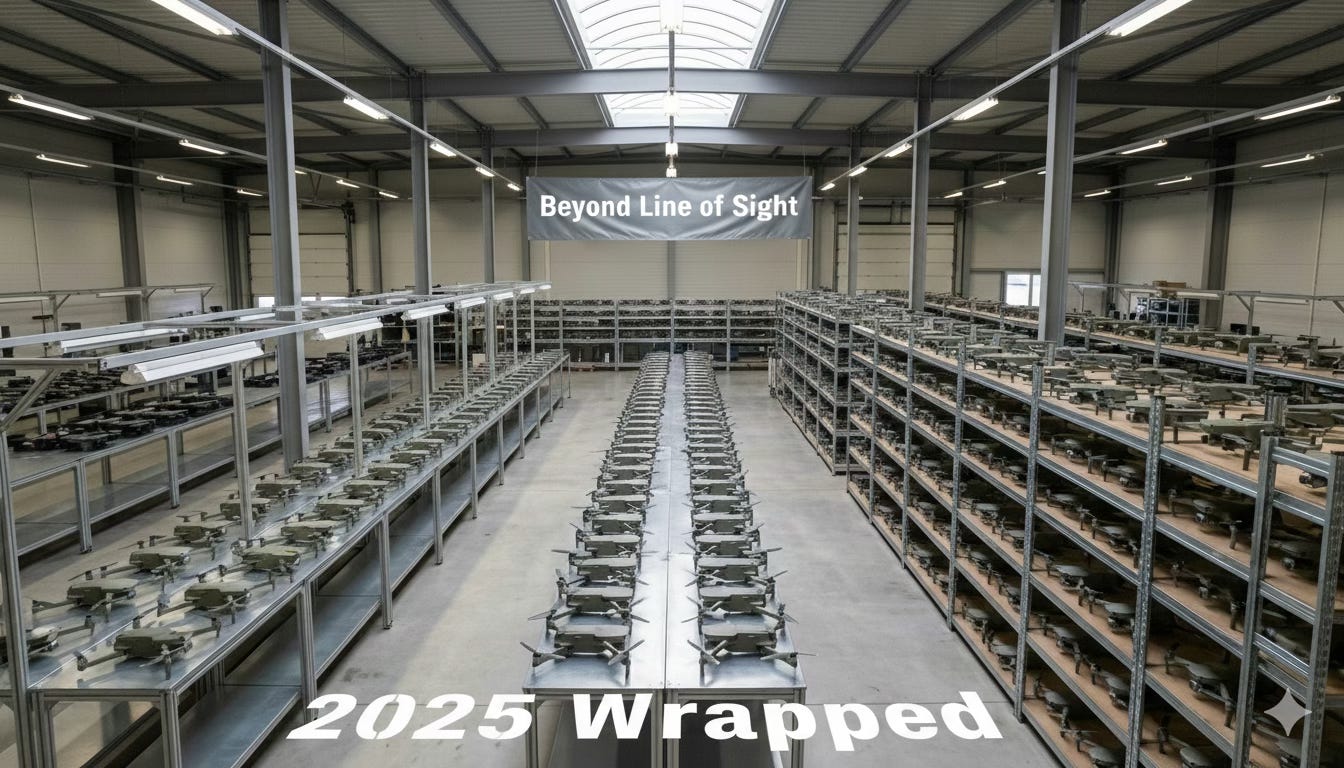
Drones are now a key part of the industrial-scale warfare. Ukraine moved towards producing and fielding millions of FPV drones annually, treating them less like platforms and more like consumable munitions. Russia responded in kind, integrating low-cost drones into both tactical and strategic concepts. Scalable volume capability, not elegance, defines effectiveness. Kremlin can now produce 3-4 million drones annually (up from 1.4 million in 2024).
NATO and partners followed suit. The UK- and Latvia-led Drone Coalition, €2.75 bn committed, one million drones pledged. That is not experimentation, that is institutionalisation. Drones are now a core budget line, not a bolt-on.
Counter-drone followed the same logic. The “Tom & Jerry” dynamic accelerated: sensors, EW, kinetic effectors, and command-and-control being pulled together into layered systems. The UK’s £140m rapid funding push is a great example: governments are no longer debating if counter-UAS is required, but how fast can it be fielded and scaled.
Verdict: Correct on direction, conservative on scale. Drones are now central to force design and defence industrial policy.
#2 “Drones as First Responders” (DFR) Unleashed
I argued that 2025 is the year DFR would properly accelerate, especially in US policing. That largely happened, helped by regulatory streamlining that cut approval timelines from months to days.
By late 2025, DFR was no longer a novelty. Departments like Redmond, San Francisco and Lakewood weren’t talking about pilots; they were talking about dispatch integration, response-time reduction, and better information before officers arrive. DFR is maturing into an operating model.
Medical drones did progress, but more slowly and unevenly. Deliveries of AEDs, blood and medical supplies expanded, enabled by better connectivity and autonomy, but largely as regional programmes rather than systemic infrastructure. Directionally right, but optimistic if read as “mainstream by end-2025”.
Criminal use, unfortunately, did exactly what was expected. Prison contraband drops, reconnaissance ahead of crimes: the same tools lowering friction for responders are lowering friction for criminals too.
Verdict: Directionally accurate. Law-enforcement DFR genuinely scaled; medical use grew but stayed patchy; criminal misuse reinforced the logic for both.
#3 Need for Alternative Supply Chains that Scale
The prediction here was that geopolitics would push the US and Europe to reduce reliance on Chinese drones and components (particularly DJI and Autel) without achieving full decoupling.
That is almost exactly what happened. The FCC’s decision to add DJI and Autel to the Covered List was the clearest signal yet that security concerns are now shaping markets, not just rhetoric. It operationalised what had been abstract risk.
Crucially, the issue extended beyond airframes to subsystems and communications, matching my original argument. At the same time, China continued to signal its own leverage via export controls on key materials.
What did not happen was a clean break. DJI remains dominant in many non-defence commercial segments, for good technical and economic reasons. Western alternatives are growing, but they are still catching up on scale, maturity and ecosystem depth.
Verdict: Correct on triggers and direction. 2025 was about starting the shift, not finishing it.
#4 More “AI this, AI that”
AI was always going to dominate the narrative. The more interesting question was whether substance would follow.
On the defence side, it did. AI moved from marketing language into planning documents, operational concepts, and procurement logic. particularly around autonomy, sensor fusion, targeting and swarm behaviour. Edge AI, not cloud AI, became the centre of gravity.
2025 saw a clear push toward onboard processing: low-power chips running vision, navigation and decision-support directly on the vehicle. For investors, AI-enabled autonomy became a core valuation driver, not a nice-to-have.
On the commercial /non-defence sectors, the constraints I flagged held. Edge AI deployments expanded in inspection and surveying, but full autonomy in dense airspace remained bounded by regulation and risk tolerance.
Verdict: Accurate. AI remained noisy, but also materially reshaped defence capability and platform economics.
#5 Slow Roasted Regulations
I described 2025 as a year of incremental regulatory progress rather than breakthrough. That framing aged well.
The FAA’s Part 108 process advanced, culminating in a Notice of Proposed Rulemaking (NPRM), but did not deliver a fully operational BVLOS regime. Europe continued along its U-space trajectory, expanding corridors and trials without a single “unlock” moment.
Frustrating? Yes. Predictable? Also yes.
Verdict: Almost exactly right. Meaningful progress, no sudden step-change.
Plus: M&A and the rise of “dual use”
I flagged a unifying investment theme: “Dual use”. It ended up being the organising logic of 2025. Examples here, here, and here.
M&A and partnerships clustered around AI-enabled drones, counter-UAS, and systems that span defence, homeland security and public safety. Defence-adjacent deal flow dominated; cargo and logistics continued, but with less gravitational pull than I expected.
Verdict: Directionally right. Dual use was the lens through which most serious capital was deployed.
So, did 2025 happen as expected?
Overall, yes. More or less. Where I missed was on speed, not structure and direction. Medical drones and cargo M&A moved slower; supply-chain shifts began but didn’t resolve; regulation plodded rather than leapt.
The bigger picture held: drones are now industrial-scale, dual-use, AI-enabled systems sitting at the intersection of defence, security and critical infrastructure. That is the baseline reality heading into 2026.
In a follow-up, I have outlined what I think 2026 will look like for aerospace, defence, and space more broadly. Not as predictions for their own sake, but as indicators of where organisational constraints are likely to surface next.
Read it here:
