

As Q4 zooms past, I hope you are starting to look forward to the winter holiday season and are starting to plan Xmas parties with family, friends, and colleagues!
Lots happened in October, but here are my three things that matter for A&D:
A New European Giant
The never-ending game of countering drones
Opportunities for shaping defence
Read on below.
A New European Giant

Airbus, Thales, and Leonardo signed an MoU to merge their space businesses into a new company. The aim is to strengthen Europe’s strategic autonomy in space. This is the boldest move in European A&D sector since MBDA.
This has spurred a comparison SpaceX / Starlink (some examples: 1, 2). It’s not about competing with SpaceX and Starlink, it’s about competing globally. And Starlink happens to be the biggest player. (it does help that mentioning Starlink, SpaceX, or Musk drives clicks)
The world is becoming less open and more polarised. On-shoring is the theme of the decade. This is not about competing with SpaceX or Starlink. This is about staying relevant and competitive globally while serving sovereign interests.
The U.S. benefits from a massive internal market from the space sector. Other nations like India and China are also fast growing in capabilities and demand. Markets like these are often large, mostly unified, and allow many players to thrive.
The European space sector is, by contrast, more fragmented. Each European nation state has its own funding, interests, and political needs. These issues won’t go away with a merger but it will streamline operations and products. It will allow the new European super-prime (and Europe) to be more competitive. If well executed…
This does risk squeezing out Europe’s SMEs. The go-ahead still depends on union and regulatory approval among other things.
One thing is certain: the European space sector will look very different by the end of the decade. This is because global competition, internal pressures, and a focus on defence are increasing.
The Never-ending Game of Countering Drones
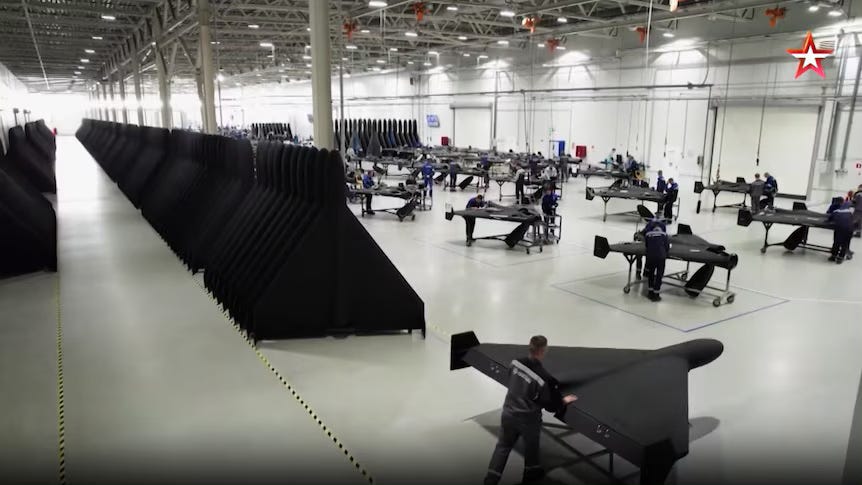
In a few short years, drones became standard operating practice on the battlefield. Ukraine now deploys 9000 drones daily and faces volleys of 800+ drones at a time from Russia. The rest of the world is playing catch-up and learning from Ukraine, fast adopting drones.
This means the demand for counter-drone solutions is only going up. Few examples from last month:
US Army to hold recurring competitions to field counter-drone tech
Europe’s “Drone Wall” Recast: The Urgency of Drone Defense in Light of Recent Incursions
AeroVironment secures a $96 million U.S. Army contract to produce counter-drone missiles
Drone and counter-drone tech development is a cat-and-mouse game. We now have a wide-range of solutions. From RF-based soft-kill solutions to drone-interceptor missiles for hard-kill. There is also a rotating barbed wire fence used by Ukraine to counter fibre-optic drones.
The issue is now two-fold:
Understanding the adversary’s fast-improving drone capabilities
Putting solutions in place fast to counter the capabilities.
Oftentimes, sheer swarm sizes can defeat the counter-drones systems. This is what Russia has been doing in Ukraine. The challenge is developing inter-operable, integrated system-of-systems that can scale for effective response. This is what Europe’s “Drone Wall” should be.
This is a problem exclusive to the front-lines. Prisons, airports, and other critical national infrastructure also have the same needs. The need for effective counter-drone solutions outstrips the need for more drones.
Observations and Opportunities in Defence
September was DSEI, October was AUSA, European Defence Week, and other events. These events have made two things clear for the West:
We need more speed — crucial and non-negotiable in the world we’re in today. Both in capability delivery and decision-making.
We need more secure supply chains — a bottleneck that needs addressing. Without this, reliable, resilient scaling up of capability is not possible.
This isn’t only for physical manufacturing, but cyber domain as well. E.g. North Korea has been targeting the European defence and UAV sector in cyber-espionage.
Speed and security result from implementing the right policy, regulations, and procurement processes. Governments need these to buy fast.
Companies need capability (skills and funding) to scale fast. With the increasing demand, here are my top five areas of opportunities within defence:
Counter-drone and counter-UXV tech — ‘bot-on-bot’ warfare is becoming a reality and the norm.
Stealth-capable drones and unmanned vehicles — demand driven by the wave of counter-drone tech.
Advanced manufacturing — ensure the supply chain can meet integrators, OEMs, and primes’ demands.
Powertrains and propulsion — piston engines, gas turbines, DC motors, rocket motors, etc.
Software and hardware for AI and autonomy to enable ‘bot-on-bot’ warfare
(The silent sixth: space-based capability. But that’s for another day)
None of this is surprising.
It is confirmation of the trend becoming the norm. Companies should leverage these opportunities for their growth.
What’s More:
Organised crime gangs in the UK are deploying “super-drones” capable of carrying tens of kilograms, raising fears of drone-facilitated prison breaks.
Stark Defence reportedly missed all four of its attempted drone strike tests in a recent proving round.
The UK and Ukraine agreed to jointly produce thousands of Octopus-100 interceptor combat drones, and more than 85,000 military drones have been delivered by the UK to Ukraine in just six months
Altitude Angel entered administration, putting the UK’s drone UTM and operator services at risk.
The Metro Police launched a new drone programme aimed at improving public safety in London.
Russia converted American-made Cessna aircraft into low-cost anti-drone fighters.
The Pentagon is leaning on government-owned, commercially operated (known as GOCO) satellites to mitigate risks amid geopolitical conflicts.
The European Commission is considering inviting Ukraine to join Europe’s GovSatCom secure satellite communications platform.
Iridium has dropped its $1 billion 2030 service revenue goal in light of SpaceX’s push for direct-to-device connectivity.
Europe confirmed its “European Space Shield” defence programme will become operational by 2026.
SpaceX successfully completed its 11th Starship test flight.
India’s HAL will build the Sukhoi Superjet 100 locally under a new industrial tie-up.
Sweden is supplying Gripen fighters to Ukraine in a defence deal supporting Kyiv’s air power.
EHang launched an AAM Sandbox initiative in Thailand to accelerate eVTOL operations in Southeast Asia.
Archer Aviation acquired Lilium’s patent portfolio.
Boeing is preparing to increase production of its 737 MAX to 42 aircraft per month following the FAA’s decision to reinstate limited certification authority.
ABOUT THE AUTHOR
Adit is the founder of Elantar, a UK-based boutique strategy and business development consulting firm specialising in helping companies grow faster in aerospace, defence, and space sectors.
Get in touch with Adit via LinkedIn.