
Welcome to Q4 2025.
Lots defence related activities in September. Let’s get started.
Europe’s Drone Wall
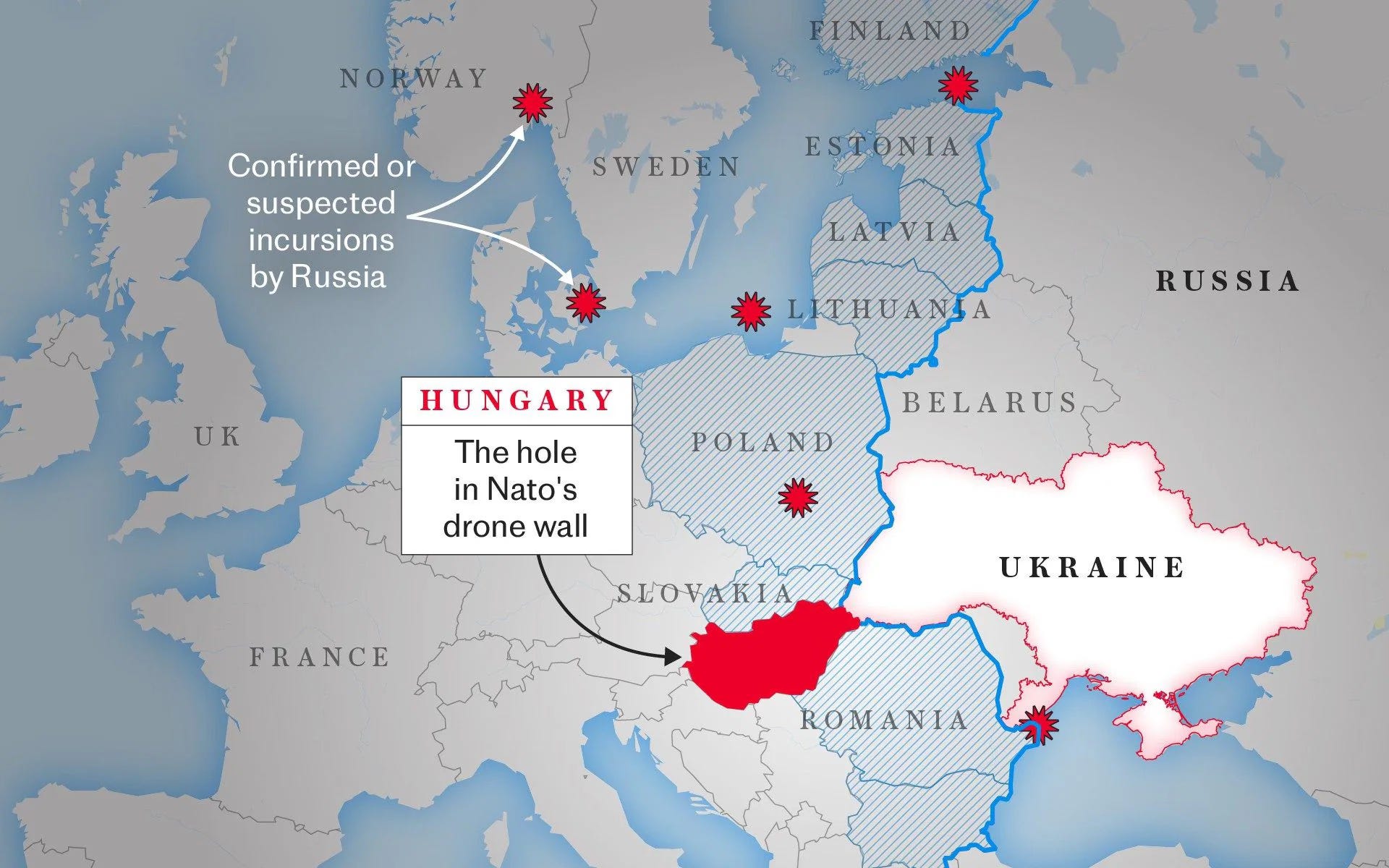
In early September, NATO fighter jets shoot down Russian drones violating Polish airspace. Later in the month, Copenhagen and other Danish airports and military sites saw drone incursions, prompting five-day civilian drone flights ban. Flights out of Munich airport cancelled due to drone sightings. NATO warships from Germany reported military drone sightings near Danish waters. These events have been attributed to potential Russian hybrid operations testing Europe’s airspace defences.
In response, the EU is fast-tracking a “Drone Wall” – a continent-wide system of sensors, electronic warfare tools, and autonomous interceptors. The initiative integrates AI-driven radar and optical detection, RF monitoring, jamming modules, and drone interceptors, aiming to provide continuous coverage along vulnerable frontiers.
The opportunity for businesses — startups and large primes alike — will be providing sensors and systems that can be easily integrated and supplied at scale. Fancy tech with AI-this and AI-that is great, but the key will be scalability and speed of the Drone Wall. This initiative should accelerate procurement and standardisation of counter-UAS solutions used within NATO and the EU.
In-Orbit Servicing: A Fundamental Tool for Militaries

Germany’s Defence Minister revealed that Russian satellites are shadowing German space assets. Later, the Head of UK Space Command mentioned that UK’s military satellites are being targeted by Russia on a weekly basis.
Germany also announced a €35Bn ($41Bn) investment in space capabilities over the next five years. It’s likely that other nations will announce similar plans. Space is now an integral part of a country’s defence strategies, along with drones, autonomous systems, and digital /cyber technologies.
In-Orbit Servicing and Manufacturing (ISAM) and Rendezvous and Proximity Operations (RPO) are slowly becoming the norm. What happened in September might just be the catalyst that accelerates the ISAM /RPO segment of the space sector.
Earlier in September, UK Space Command and US Space Command conducted their first joint military operation in space by performing an RPO to assess the status of the UK’s SKYNET 5A communications satellite.
While majority of Germany’s announced investment in space capabilities will likely focus on ISR, communications, and cybersecurity, orbital soft-kill, hard-kill, and in-orbit manipulation capabilities will become an increasingly important part of this.
The recent UK-US joint RPO to assess the status of the UK’s Skynet 5A comms satellite is a great example of this. The US and China have also been showing off their capabilities to monitor each other’s space assets.
In all of this, ISAM and RPO are emerging as fast-growing space market segments. Germany, Europe, and the world will increasingly invest in space defence, with space robotics and autonomy as key enablers.
Just as drones created a market for counter-drone interceptors, ground and space-based ASAT (anti-satellite) weapons and other hard-kill interception capabilities will become a big part of space defence.
Point—to—Point: Anywhere on Earth in under an hour

Hypersonics and re-entry physics have long been the domain of ICBMs and orbital vehicles, but now Earth-to-Earth space travel is seemingly gaining traction—driven largely by defence.
Some time ago, in reference to Starship, Musk has framed the concept as “anywhere on Earth in under an hour” using Starship. Blue Origin and Anduril Industries secured contracts to explore rapid rocket-based military cargo delivery. The goal: move supplies anywhere in the world faster than conventional transport, potentially reshaping logistics and battlefield readiness.
Companies developing advanced materials, reusable launch vehicles, in-orbit servicing, guidance systems, and rapid re-entry technologies stand to benefit long term. Keep an eye on this. Beyond defence, breakthroughs here could spin off into commercial cargo, emergency response, and even time-sensitive manufacturing.
What’s More:
Reports of Boeing exploring concepts for a next-generation narrow-body jet to replace the 737-MAX have been denied by Boeing, calling them “misleading”.
Beta Technologies has filed for an IPO on the NYSE to fund its electric aircraft and charging systems.
The EU pledged €6 billion to boost Ukraine’s domestic drone production capacity.
Boeing, Northrop Grumman, General Atomics and Anduril are all in line to produce conceptual designs for the Navy’s Collaborative Combat Aircraft program
In the UK, TEKEVER opens a new Swindon facility and Quantum Systems invests €50 million for UK expansion, the Royal Navy brings new logistics and ISR (Scheibel drones into service, and efforts to deploy British-made FPV “kamikaze” drones remain stalled by MoD procurement delays.
Looking eastwards, China is co-developing military UAVs with sanctioned Russian firm IEMZ Kupol, converting old J-6 fighters into supersonic drones, and unveiling new stealth designs like the “Type B” and a tailless unmanned fighter. Chinese eVTOL maker EHang is expanding China’s civil aerospace reach with the upcoming launch of its long-range VT35.
Out of India, ideaForge’s Q6 V2 UAV receives a NATO stock number, India accelerates its indigenous Tejas Mk1A fighter deliveries to replace aging MiG-21s, and moves forward with bids for its next-generation AMCA stealth fighter with seven firms competing.
Joby Aviation, Skyports, and RAKTA plan to launch an air taxi network in Ras Al Khaimah by 2027, and Joby demonstrates autonomous “SuperPilot” flights during a U.S. defense exercise.
In space, China and the U.S. are laying groundwork for low-Earth-orbit traffic control after a near-collision incident, while Avio secured a €40 million ESA contract to design a reusable upper stage. In Europe, investment firm Seraphim launched a Berlin subsidiary and Planet Labs plans major investment in a new satellite production site there. Meanwhile, SpaceX readies tests of its direct-to-device spectrum service and Musk says Starship will begin launching 100 tons to orbit next year.
ABOUT THE AUTHOR
Adit is the founder of Elantar, a UK-based boutique strategy business development consulting firm specialising in helping companies grow faster in aerospace, defence, and space sectors. Get in touch via LinkedIn if you need help growing faster.