

Welcome to this week’s Beyond Line of Sight!
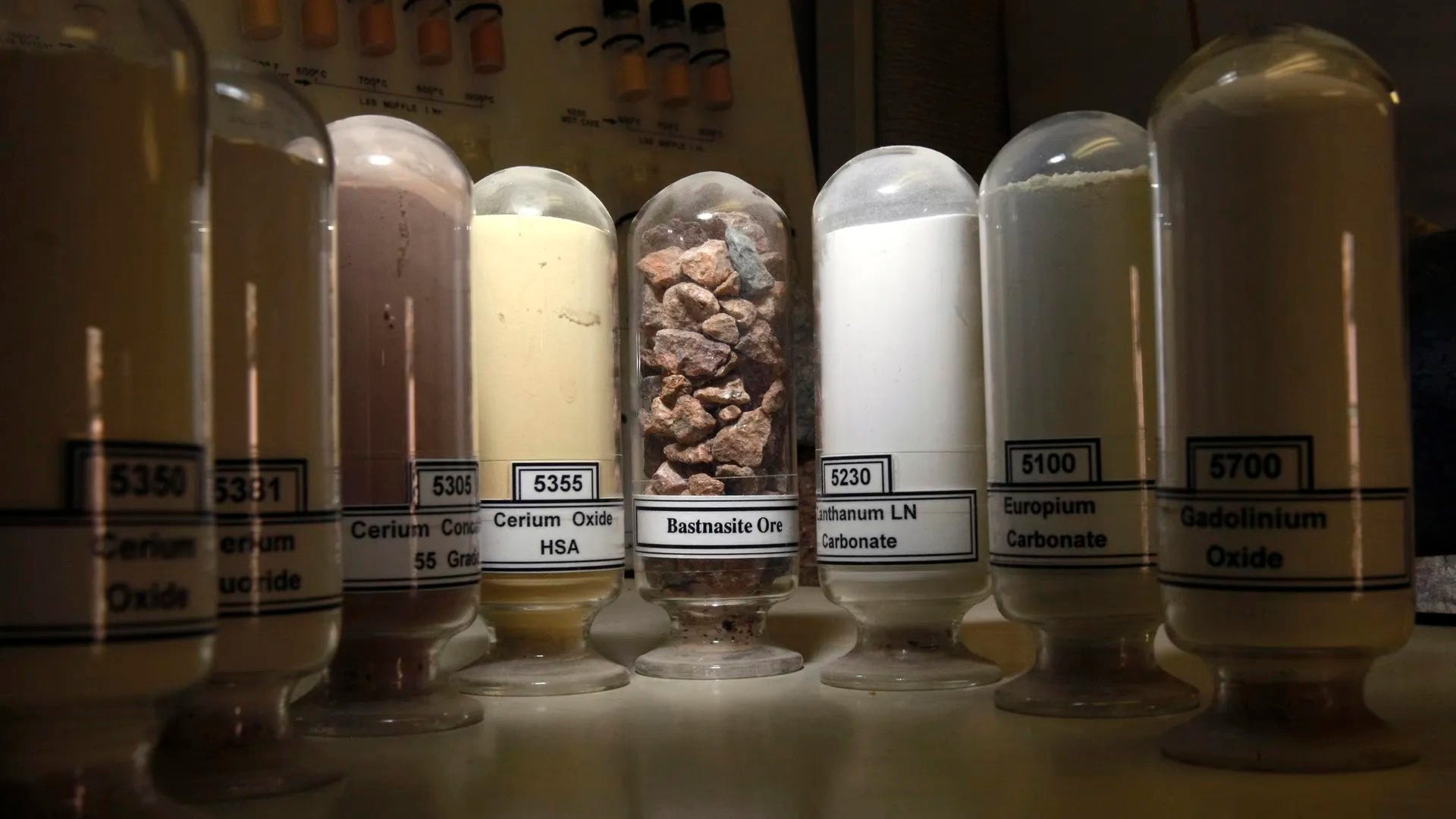
About a week ago, China imposed stringent export controls on rare earth elements (REEs) as part of the escalating U.S.-China trade war. While not an outright ban, it requires onerous licenses that may take several months to process, more if it is for exports to the U.S. This impacts industries globally, not just the U.S.
According to the International Energy Agency’s (IEA) outlook, China controlled about 61% of REEs production and 90% of refining in 2023. While this number is expected to drop to about 54% for production and 77% for refining by 2030, REEs supply is still very much concentrated on China.
The U.S. has only one operational rare earths mine, owned by MP Materials, but it does not have the capacity to separate heavy rare earths and has to send its ore to China for processing. MP Materials has now stopped sending ore to its Chinese partners for processing.
Key drone components like high‑strength magnets, sensors, and navigation modules, depend critically on REEs like neodymium, dysprosium and yttrium. For drone component and sensor manufacturers as well as for OEMs, China’s onerous export control licensing requirements have a huge impact.
Here are 4 strategies that companies should consider to mitigate short and long-term impact and dependencies.
1/ Diversify Supply Chain
Pretty obvious and usually the first thing to consider. Diversify through sourcing REEs from other countries. Australia, Brazil, South Africa, Saudi Arabia, Japan, and Vietnam all have initiatives and investments underway. For companies which depend on drone components potentially affected by REEs from China, it is worth assessing supply chain resilience and diversifying.
2/ Reuse Materials and Components
Reusing materials and components works in some cases, for certain types of drone missions. For example, degraded motors or magnets may still be sufficient for less demanding applications. Where this is possible, the supply chain can be less dependent on new materials and components.
3/ Recycle Materials
Similar to reusing materials, recycling REEs is another great option. Today, only around 1% of end-of-life REEs are recycled. However, this is a growing market with long term potential. Even though using recycled REEs for applications like magnets will be slightly degraded in performance compared to virgin REEs, they will be vital for less demanding (and cost-sensitive) applications.
4/ Buyback Programs
Introducing buyback programs (often called ‘Trade-in’) can work well. Apple, Samsung, Dell, and so many other hardware tech companies have been successful in implementing these. Both OEMs as well as component manufacturers could leverage this to reuse and recycle materials and components.
Bonus: if you’re a drone motor manufacturer, look at REE-free motors to reduce dependence on REEs altogether.
The Headlines
Defence and Security
The British Army has tested a Radiofrequency Directed Energy Weapon that disables drone swarms for just 10 pence per shot, marking a major step in cost-effective drone defense.
India has demonstrated its MK-II(A) laser weapon system, capable of destroying drones with high-energy beams, advancing its position in next-gen defense technologies.
Turkey’s Bayraktar TB2 UCAV became the first drone to autonomously perform a barrel roll, showcasing its advanced manoeuvrability and autonomous flight capabilities.
Turkey also tested its stealth drone ANKA III with the Super Şimşek decoy, advancing its “loyal wingman” concept for unmanned-manned aerial combat teaming.
Commercial
A Chinese 50kg hydrogen-powered drone set a national record with a 30-hour flight, highlighting progress in green aviation and smart tech integration.
Partnerships
Quantum Systems and Ukrainian firm Frontline are teaming up to boost Ukraine’s counter-drone tech and scale local defense production. Quantum Systems also partnered with RENK India to co-develop drone systems, supporting India's "Make in India" push and expanding production by 2025.
Embention has joined the ACTUS project to provide critical avionics and ground systems for Europe’s certified tactical drone operations.
Money Matters
Contracts
Palantir: NATO has acquired the AI-powered MSS NATO system to boost battlefield decision-making and intelligence fusion, with deployment set within 30 days.
Duality AI: awarded a U.S. Army contract to develop a simulated anti-drone system for its new XM30 combat vehicle using AI and digital twin technology.
Investment and M&A
General Atomics has invested in Dutch firms Emergent and Saluqi to advance autonomous swarm tech and compact aerospace motors for unmanned systems.
Skyports has acquired Redbird Aero to launch drone delivery and inspection services in Australia, starting June 2025.
UK-based PDG Aviation has acquired Team UAV to integrate drone-based inspections with manned aviation for more versatile aerial solutions.
Recommended Reading this Week
Silicon Valley’s Military Drone Companies Have A Serious ‘Made In China’ Problem
HAPS Advantages in an Era of Satellite Connectivity (PDF White Paper)
ABOUT THE AUTHOR
This newsletter is authored by Adit Shah, a UK-based business and strategy consultant specialising in aerospace, defense, and space sectors. For contact, please get in touch via LinkedIn.