

Welcome to this week’s Beyond Line of Sight!
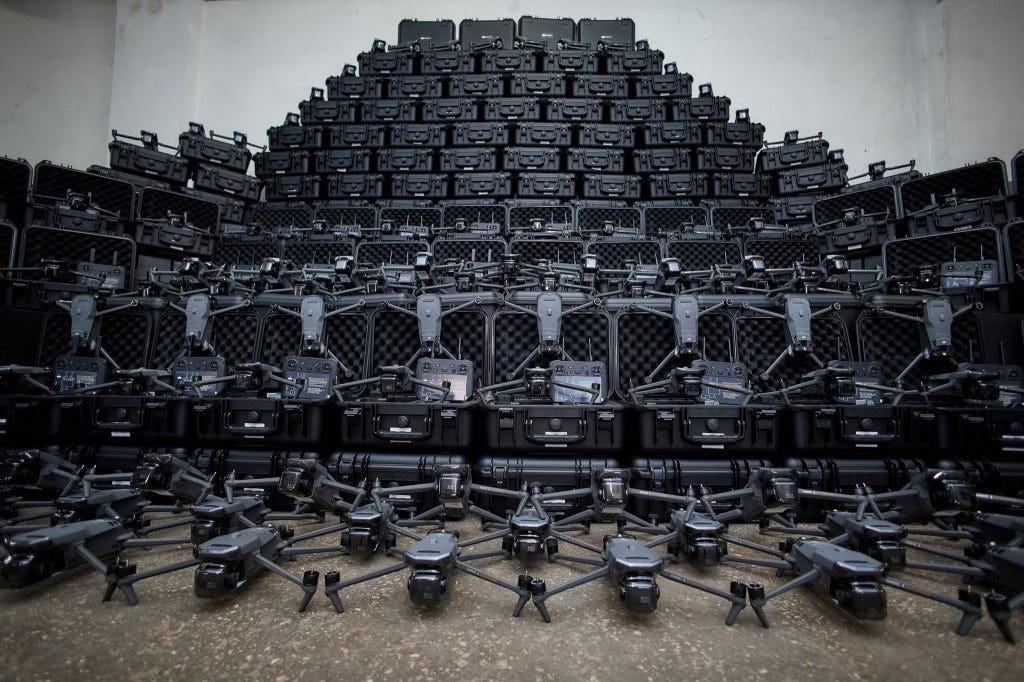
The drone industry is changing fast. Wars and unrest in Ukraine, Israel, Syria, and elsewhere has shown that drones are becoming key for defence. This is true for commercial and civil uses as well. Drones for agriculture, police surveillance, firefighting, food delivery, and much more are fast becoming the norm.
Companies are still constantly innovating, but reality is that features and performance are starting to converge and standardise. There are hundreds of different quad-rotor and fixed-wing VTOL drones available that look and perform much the same. In short, drones are commoditising.
Standing-out is already getting more difficult as end users start to see drones as a commodity. Companies that want to thrive in a commoditising market can’t rely on technology alone to grow fast—they need to rethink how they create value.
Competing on price is the easiest option, but it’s a race to the bottom. Companies that thrive are those that go beyond selling hardware. They focusing on services, data, and building solutions. Here are some ways of making it work.
Drone-as-a-Service (DaaS)
Many industries have moved away from one-time purchases in favor of subscription models—drones are no different. Instead of selling a drone outright, businesses can offer it as a service, bundling in maintenance, software updates, and even insurance for a predictable monthly or annual revenue.
Take Zipline for example. Rather than just selling small cargo drones, they offer drone delivery services to the likes of superstores, hospitals, and businesses. Their customers don’t buy the drones, they buy the drone-based delivery service.
Sell Data not Drones
At their core, drones with sensor payloads collect data. The real opportunity isn’t in the hardware—it’s in the data.
AgEagle figured this out early. They started as a drone manufacturer but pivoted to agricultural analytics. Instead of competing with big names on hardware, they help farmers monitor crop health through data-driven insights, where the real value is.
Provide End-to-End Solutions
Selling just one part of a solution leaves space for competitors to step in. The companies that succeed in commoditised markets are those that offer end-to-end solutions.
Skydio does this well. Their AI-powered drones don’t just take pictures—they analyze them, sort the data, and feed it into existing security or inspection systems. By handling the entire workflow, they have are growing fast within first responders and security markets.
Create a Platform, Not Just a Product
If hardware is becoming a commodity, software and services can still be premium. The fact that Apple’s App Store makes the iPhone more valuable also applies to drones.
DroneDeploy has embraced this by building an open platform where developers can create apps tailored to different industries, from construction to agriculture. This approach not only drives innovation but also keeps customers locked into their ecosystem.
What about Drone Component and Subsystem Providers?
It’s not just drone manufacturers and integrators facing commoditisation. As component and subsystems like motors, sensors, and batteries standardise, companies supplying these also become commodity suppliers.
To stay competitive, component and subsystem providers need to move beyond selling individual components and instead focus on offering value elsewhere.
Here’s how:
Develop Smarter, More Integrated Components — Providing sensors isn’t enough. Companies should offer advanced features such as AI-powered image processing, predictive maintenance, or more efficient power management. This adds value beyond raw hardware.
Bundle with Software and Services — A motor manufacturer, for example, could offer diagnostics and predictive analytics to help drone operators optimise performance and reduce downtime.
Become a Critical Part of the Ecosystem — Companies that integrate seamlessly with multiple platforms and make their products essential across different drone models will have a stronger position than those offering standalone parts.
Focus on Reliability and Performance — In applications such as defence, logistics, or inspection, reliability is paramount. Positioning components as premium, mission-critical solutions rather than just generic parts can help justify a higher price.
Offer excellent after-sales support — Companies that offer excellent after-sales support that creates peace of mind and confidence. This can be done through warranties, quick response customer support when needed or additional support to help differentiate from competitors.
Pro tip: combine 2-3 of these if possible.
The Takeaway:
The shift in majority of value created is moving downstream as the drone industry grows and matures. Drone companies selling hardware re-think their value propositions and value chains for the long term for growth. Think about services-based value creation leveraging the hardware.
The Headlines
Defence and Security
Ukrainian manufacturer Sky Defenders has introduced the 'ZigZag,' a fixed-wing drone with four gun barrels for intercepting and targeting enemy drones.
President Zelensky announced that Ukraine's long-range drone has successfully completed a 3,000 km test flight.
Ukraine's new UAS SETH loitering munition, similar to Iran's Shahed-136 drones, has been deployed by the 12th Azov Special Operations Brigade.
In the Middle East, the U.S. Navy intercepted and destroyed a dozen drones launched by Houthi rebels in the Red Sea.
A South Korean Army helicopter was destroyed after being struck by an Israeli-made Heron drone, marking the third incident involving this drone, while the Army investigates the cause.
China’s Yitong UAV System Co. has successfully flown the TP1000, a 1-ton unmanned cargo aircraft with a 1,000 km range.
The U.S. Air Force is testing the TowFLEXX, a remote-controlled electric tug to improve MQ-9 Reaper maintenance, potentially saving 3,000 man-hours annually.
Taiwan released its latest Quadrennial Defense Review, which focuses on enhancing indigenous defence technologies, with advancements in anti-drone command systems and satellite payloads aimed at improving tracking and threat analytics.
Swedish Air Force, Swedish Defence Materiel Administration, and Saab have partnered to developed the "Loke" counter-drone system, integrating radar and remote weapon stations.
Legal
DJI has filed a lawsuit against the U.S. DoD to challenge its designation as a "Chinese Military Company", arguing that this label is unjustified, as it produces consumer and commercial drones, not military equipment.
Partnerships
Mach Industries has partnered with HevenDrones to produce UAVs at Mach's Forge Huntington facility in California. This collaboration aims to counter Chinese dominance in the drone market by manufacturing HevenDrones' H100, H2D55, and Raider models domestically.
Money Matters
Contracts
Northrop Grumman: $267.2 million contract from U.S. Navy to supply two additional MQ-4C Triton drones, with delivery expected by October 2028.
Investment and M&A
Flock Safety has raised $275 million in a funding round led by Andreessen Horowitz, bringing its valuation to $7.5 billion.
Neros has secured $35 million in a Series A funding round led by Vy Capital US, with participation from investors like Sequoia Capital and D3.
Recommended Reading This Week
How Amazon proved its new delivery drone is safe for takeoff
ABOUT THE AUTHOR
This newsletter is authored by Adit Shah, a UK-based business and strategy consultant specialising in aerospace, defense, and space sectors. For contact, please get in touch via LinkedIn.