

It’s almost year-end, and nearly the holiday season.
I hope your 2026 business plans are ready for execution or at least being planned.
This month, my focus has been on events in the UAE, Europe, and the UK.
Read on.
The Third Pole: Industrialising UAE A&D

November’s Dubai Airshow showcased the UAE’s ambition and the rising weight of the region in global aerospace and defence. Themes revolved around drones, autonomy, and AI, seasoned with a pinch of space tech—similar to Paris, Farnborough, Bengaluru, and beyond.
The difference is the speed. The UAE is moving at a staggering pace, amplified by ambition backed by serious capital. EDGE alone unveiled 42 new systems across autonomy, weapons, propulsion, space, radar, and secure comms. They announced over $7bn in commitments and 21 partnerships with Anduril, L3Harris, Leonardo, and Lockheed. Tawazun added $6.65bn in deals. And that’s just the headlines.
What’s emerging is not a UAE caught between Western and Chinese suppliers—it’s the UAE building a third pole: an independent industrial centre that forges balanced partnerships across blocs while developing platforms that increasingly compete with Western, Chinese, and other offerings. This is powered by Abu Dhabi’s sovereign funds, acting not as passive investors but as long-horizon industrial architects.
The UAE is betting big on sovereign industrialisation: localisation, tech transfer, and deep supply chains built with both Western and non-Western partners.
For A&D suppliers, the window of opportunity in the Middle East is very real. Those who plug in now will ride this wave well into the 2030s.
CM25: Europe’s Sovereign Space
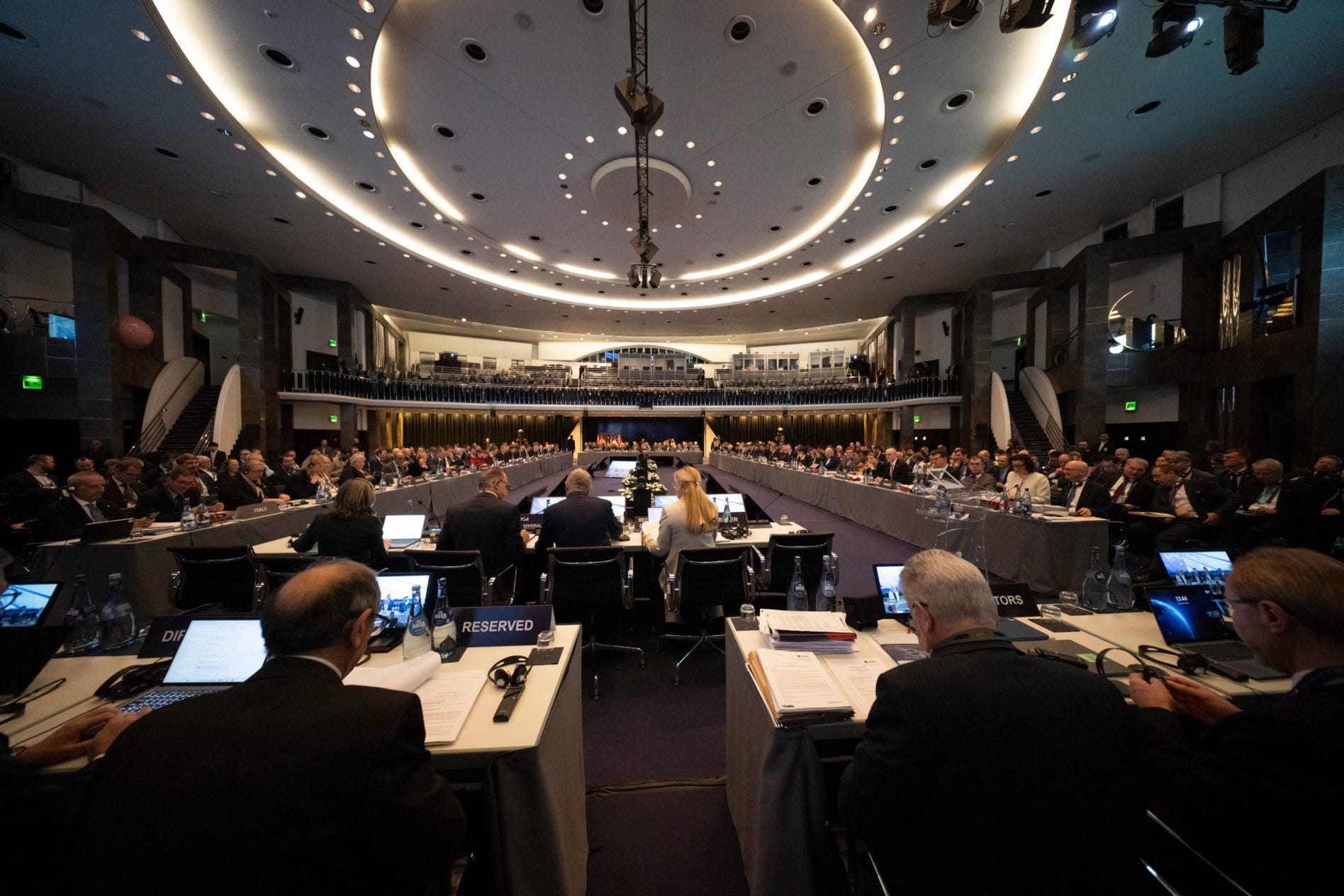
The ESA Ministerial Council 2025 concluded with a record €22 billion approved by member states. This historic funding underscores a clear focus on self-reliance and dual-use capabilities, reflected in the oversubscription for Space Transportation alongside investments in Earth Observation, secure communications, and PNT.
The same infrastructure now underpins civil programmes, scientific missions, and defence applications — from ISR to secure satellite connectivity. Europe is moving toward a resilient, sovereign space ecosystem, reducing reliance on US and foreign launch and service providers.
While it’s disappointing that Human and Robotic Exploration remains undersubscribed, this likely reflects rising economic and political pressures across the UK, Europe, and beyond rather than a lack of ambition.
For European space companies, the takeaway is clear: programmes and supply chains tied to launchers, dual-use technologies, and secure infrastructure represent the most immediate and high-impact opportunities. ESA is a strategic anchor for a sovereign, commercially competitive, and defence-relevant European space sector.
UK Space: Act Now or Lose Out
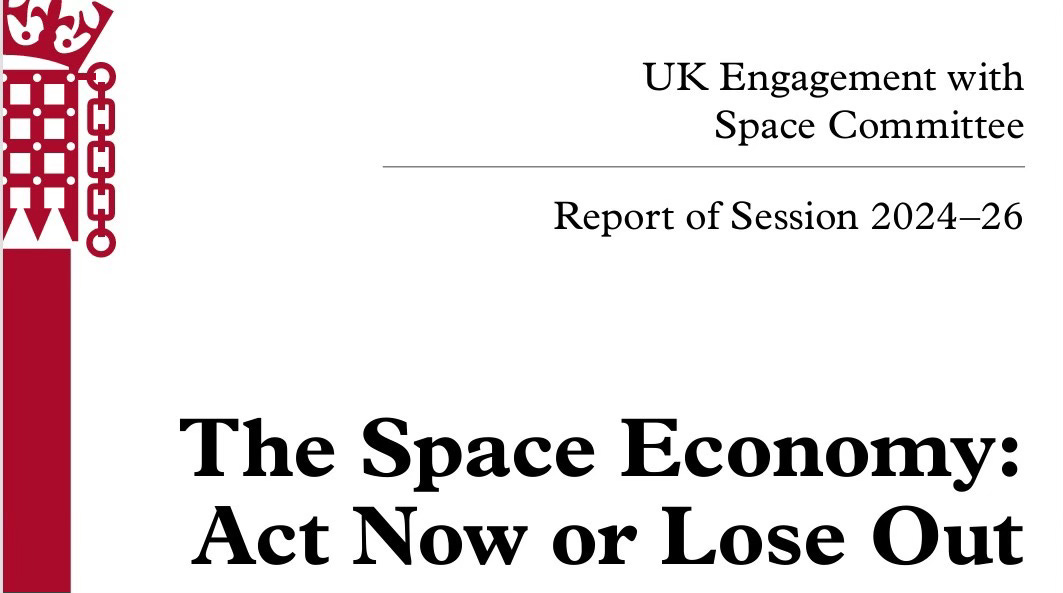
From Europe, now to the UK. The House of Lords published its report on the UK Space Industry in early November. It couldn’t be clearer: ‘Act Now or Lose Out’. It’s a message the sector has repeated for years: UK ambition in space far outpaces investment, focus, and delivery.
The UK once had sovereign launch capability and gave it up. Repeating this mistake is national security suicide. Launch access is Critical National Infrastructure, and it should be treated, funded, and secured as such. But the UK can never match the US, China, or India on launch cadence or orbital range. Geography and scale make that impossible.
Instead, the UK needs to take a long-term, strategic view and double down on the parts of the space economy where the UK already leads and where the future value will concentrate.
The future isn’t Earth-to-orbit. Access to space is no longer the bottleneck. The next frontier is space-to-Earth and space-to-space: building capability, services, and infrastructure that connect, sustain, and scale activity in orbit.
This is where the UK has real leverage: in ISAM, advanced manufacturing, space science, systems engineering, and policy and governance. These strengths matter not just commercially, but for defence and national resilience.
Given the economic and political climate, the UK needs to focus on dual-use technologies and the supply chains that enable them. UK-based companies should align their efforts with these national strengths while delivering solutions that serve both commercial and defence needs.
What’s More:
Three high profile crashes: Tejas LCA crashed during Dubai Airshow 2025 killing Wing Commander Namansh Syal, 20 fatalities as Turkish Air Force C-130 breaks apart mid-air, and a UPS MD-11 cargo plane crashed shortly after takeoff in the US, killing at least 12 people.
The U.S. Air Force launches a program to develop affordable anti-air missiles targeting $500k per unit, aiming to scale capabilities for large-scale conflicts.
The Trump administration is pressuring Congress to grant sweeping new powers to shoot down drones at public events, critical infrastructure, and prisons.
The U.S. Army aims to buy at least a million drones in the next two to three years and could acquire anywhere from a half million drones to millions of them annually in the years that follow.
Britain is providing military support to Belgium following a series of suspected Russian drone incursions into Belgian airspace.
Boeing is set to end production of three aircraft in 2027: the F/A-18 Super Hornet, the Boeing 767-300F freighter, and the Boeing 777F.
USAF plans to reduce its F-35 purchases until 2028 due to upgrade issues and financial constraints and is prioritising the development of the F-47, with the first prototype flight expected in 2028.
EHang has successfully completed a series of trial air taxi flights with its EH216-S pilotless electric Vertical Takeoff and Landing (eVTOL) aircraft in the core district of Doha, Qatar.
Archer Aviation has successfully completed an in-country eVTOL flight test campaign for its Midnight aircraft in the UAE’s local operating environment and over desert areas.
China’s experimental Shijian-21 and Shijian-25 satellites have separated in geosynchronous orbit after being docked for months conducting apparent low-profile on-orbit refuelling tests.
Jeff has had a good month: Blue Origin’s New Glenn launches NASA’s ESCAPADE spacecraft to Mars while successfully recovering the booster.
Project Kuiper becomes Amazon Leo ahead of LEO broadband service debut.
A Soyuz launch to the ISS causes damage to the Baikonur launch pad, delaying subsequent flights.
Rocket Lab has pushed the first launch of its medium-lift Neutron rocket to 2026.
ABOUT THE AUTHOR
Adit is the founder of Elantar, a UK-based boutique strategy and business development consulting firm specialising in helping companies grow faster in aerospace, defence, and space sectors.
Get in touch with Adit via LinkedIn.