

About 10 years ago, I made the best mistake of my career (so far).
I left my cushy engineering role at Airbus Commercial Aircraft to found a space robotics company. My co-founder Stuart and I, both starry-eyed engineers, started Space Platform Technologies Ltd (SPTL) with a vision to make space sustainable.

Our hypothesis was simple: with access to space becoming easier (thanks to SpaceX, Rocket Lab, and others), the next big bottleneck would be operating in high value, increasingly crowded orbits, and doing so safely without creating more debris.
Our solution was to build a modular satellite platform with a detachable payload. Since high value orbits would be crowded and RF spectrum is a limited natural resource, rather than decommissioning the whole satellite, you’d decommission only the payload while keeping the satellite bus, its comms links, and everything else intact. For this, we needed two key things to work: robotically detach the old payload and attach a new one, and have a space tug that can do the “last-mile” logistics part of bringing the new payload to rendezvous with the platform and de-orbit the old one.
When we started testing this concept with the market, we didn’t get anything more than “that’s interesting”. We quickly pivoted towards the life-extension and debris removal aspects of the in-orbit servicing and manufacturing market and started getting some traction, because satellite debris was starting to be recognised as a real issue. Still, it was a nascent market with no clear revenue model, and our technology concepts were also nascent.
We were trying to fly before we knew how to walk, run, and take off. Neither of us had any commercial experience, but Stuart had space engineering experience and led most of technical development, while I looked at the overall systems architecture (something I’d done for aircraft) and ran all commercial activity. I had to learn navigating commercial problems fast, build a network in the space sector from zero, and teach myself space systems engineering as I went. We made real headway - recruited an intern, a couple of experienced space systems engineers, and great support from the UK Space Agency and a couple of UK universities.
SPTL ultimately had to be shut down. The market was nascent, and our technology was also nascent, and I didn’t know how to deal with both at once.
That was 10 years ago. This is today. SPTL was the best mistake of my career so far, because it taught me more about business and how to commercialise deep tech in heavily regulated markets than any MBA program could have. I ended up at Prismatic (later acquired by BAE Systems), helping develop nascent HAPS technology into a nascent stratospheric operations market.
And now through Elantar, with one of my clients, Inductive Power Projection (IPP), we’re commercialising nascent high-power (kilowatt-scale) inductive charging technology into nascent market sectors around full autonomy - from subsea to the Moon and everything in between.
Why nascent-on-nascent is a different kind of hard
Here’s what I got wrong back then, and what I keep seeing in the deep tech founders and teams I often work with: we were trying to commercialise the same way you would into an established market, without realising none of those moves were actually available to us.
When you’re bringing nascent tech into an established market, the job is anchoring - you borrow the market’s existing reference points. “It’s like X, but better in this specific way” works because the buyer already has a shelf to put you on. You’re arguing for a better spot on that shelf, not building one from nothing.
When the market is nascent too, there’s no shelf - no established norms, no standard solution, and nothing in that market to anchor the tech to. So you end up having to do two jobs at once - educating people on a problem they don’t know they have yet, and educating them on the technology that solves it, at the same time.
Underneath both of those is a harder pill to swallow: nascent tech doesn’t just need something to anchor to, it needs a market that actually exists to sell into. You can have the right technology and still have nothing to commercialise, simply because the market you’d be selling into doesn’t yet exist.
SPTL had nothing solid to anchor “modular satellite platforms” to - nobody had a shelf for that yet. We did get a loose anchor once we pivoted towards in-orbit servicing, as debris, sustainability, and life extension started getting recognised as real problems worth solving. It wasn’t much, but it was something the market could finally place us against.
Market-Technology Maturity framework
Here’s a framework to think about this - technology maturity on one axis, market maturity on the other.
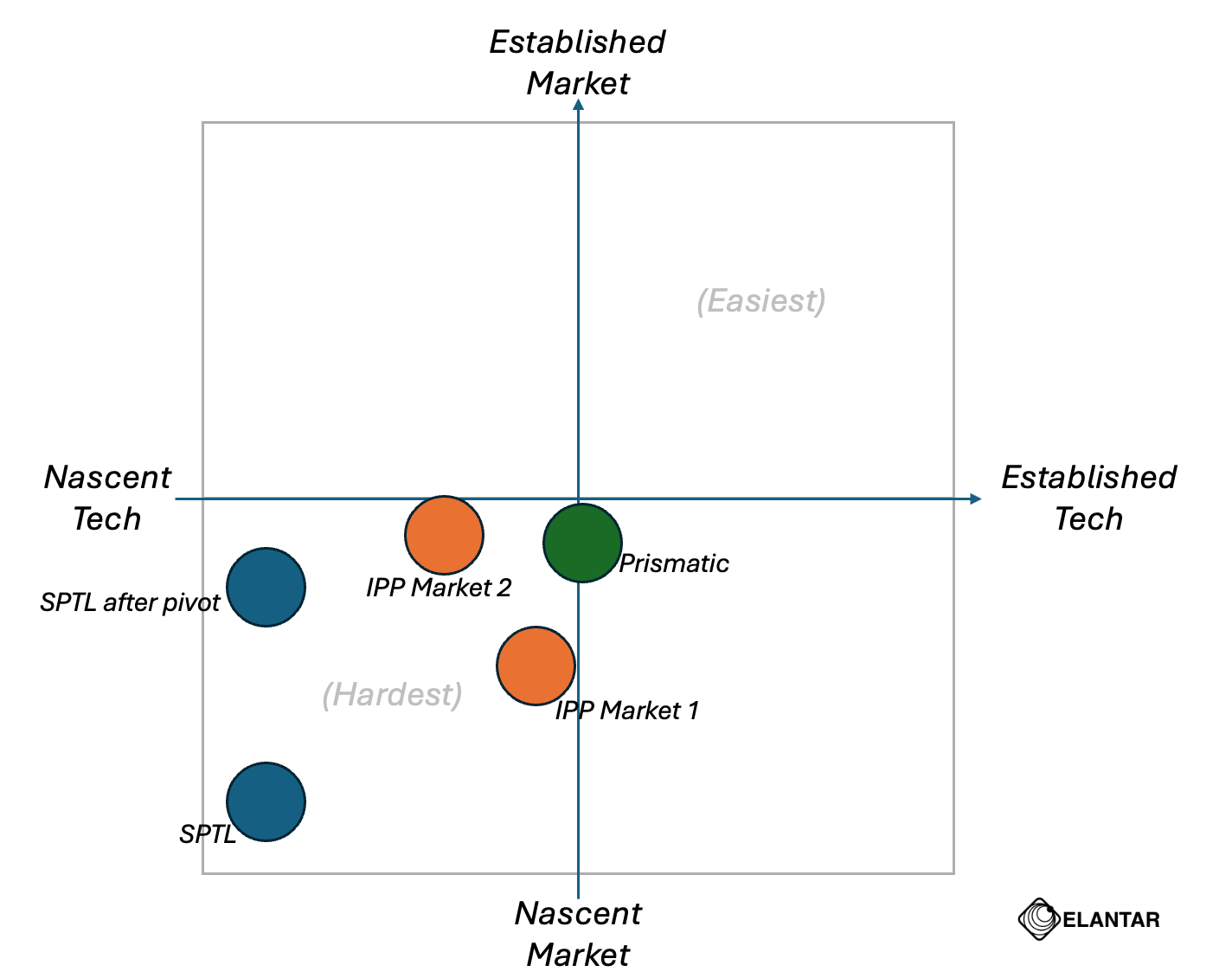
Established tech in established market (top right) is the easy corner, relatively speaking. This is what most business and startup growth advice is written for. Nascent tech, established market (top left) is hard but tractable, because you know who’s buying and how. Established tech, nascent market (bottom right) is a different kind of hard, but you’ve got something real to point at, even if the application is new. Nascent tech, Nascent market (bottom left) is where companies quietly struggle and die. No shelf for the buyer to put you on, no track record or proof. Every “that’s interesting” could mean they’re close but not ready, or it could mean never.
SPTL sat deep in the bottom left quadrant. In hindsight, our hypothesis probably wasn’t wrong. In-orbit servicing, modularity, and satellite life extension - all of these have turned into real opportunities today. The market and the surrounding technology needed years to mature before an idea like ours could land, and we didn’t have the runway to wait around for that to happen.
IPP sits somewhere different, still in the bottom left quadrant, but its position varies for different market segments. The applications are new; nobody has deployed kilowatt-scale inductive charging for subsea or on the Moon before, but the technology itself is proven and working. The same technology can sit in different places on this grid depending on which market you’re looking at - more established in one application, back in the more nascent quadrant in the other.
Prismatic sat somewhere different again (probably just below the centre point of the grid). HAPS technology has come a long way since, but back then it was genuinely immature. Stratospheric operations already had something resembling a procurement path, though the tech still carried a lot of uncertainty - for example, operations in high latitude regions during winter months.
What could actually work
A few things tend to separate the companies that successfully enter nascent markets with nascent technologies:
Sell what’s already proven somewhere, even if the grand vision sits somewhere else. Capturing the ambitious market is the destination, not the first customer.
Sequence markets by readiness. The most exciting opportunity and the most winnable opportunity are rarely the same one at the start.
Let the easy wins fund and de-risk the hard ones. “This already works, here’s where it’s operating today” is a completely different conversation than some level of “trust me, it’ll work”.
If you’re building something right now, plot yourself honestly on that grid - not where you’d like to be, but where you actually sit today. How proven is your tech, even if the proof is in an adjacent application? Does the buyer have any frame of reference for what you do, or are you their first data point? And ask the question that actually killed SPTL: do you have the runway to survive both technology and market maturity before you run out of money, or are you betting the company on being early and right at the same time?
Being early isn’t a strategy. It’s a bet on timing, and timing isn’t something you control. With SPTL, our hypothesis was broadly right - we just didn’t have ten years to survive while the market matured to what it is today.
If you’re sitting in that hard corner right now and want a clearer read on exactly where, I’ve built the Commercialisation Readiness Check for that. One clear answer on what’s actually blocking you. Takes less than five minutes, costs nothing.
More next month.