

Welcome to this week’s Beyond Line of Sight!
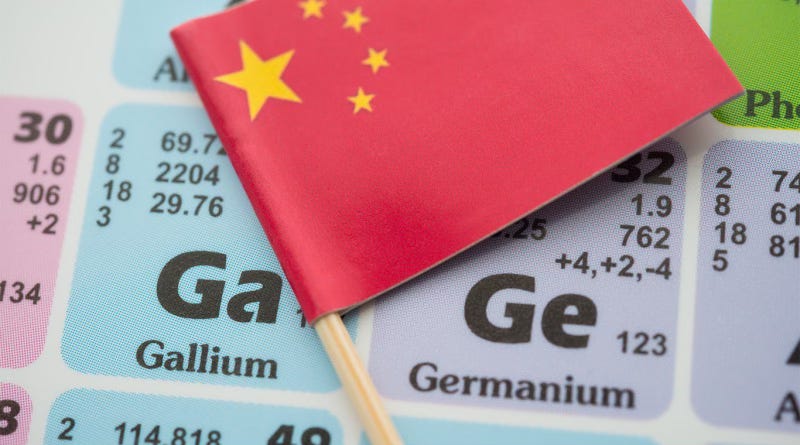
A few weeks ago, China imposed stringent export controls on rare earth elements (REEs) as part of the escalating U.S.-China trade war. While not an outright ban, it requires onerous licenses that may take several months to process, more if it is for exports to the U.S. This impacts industries globally, not just the U.S.
The newsletter on this topic (link below) last month was well received.

As this was well received, let’s break down the four strategies into more detail in this 3-part series to understand how to successfully implement each.
Supply Chain Diversification (this newsletter)
Reuse and Recycle
Buyback
Supply Chain Diversification
Drones, like most modern equipment with electric motors and electronic components, depend on REEs. China currently dominates REE mining and processing. More countries are becoming REE suppliers, however even by 2030, China is expected to have more than half of global REE production and 3/4th of global processing. U.S. imports 80% of its REE from China.
Diversifying supply enables companies to mitigate impacts on price spikes and export restrictions. Most companies in the drone sector don’t directly buy REEs, component manufacturers downstream in the supply chain will. It is crucial that companies work together with their supplier base to ensure diversity and limited reliance on just one country or source. Build this part of your supply chain assessments on a regular basis.
As part of developing and implementing supply chain diversification strategies, work with downstream suppliers who use REEs for components and parts production. Here are three key ways to diversify:
Allied Suppliers: Work with trusted partners like U.S., Australia, Canada, Japan and the UK. For example, Australia’s Lynas Corporation is building a rare-earth separation plant in Texas, and heavy-REE processing with $258M U.S. funding. The U.S. now treats Australia, Canada and the UK as “domestic” under its Defense Production Act. Nearer to home, MP Materials’ Mountain Pass mine in California produces light REEs and is adding a magnet plant in Texas. Likewise, the Lacoste and Rare Element Resources mines in North America, and the NioCorp project in Nebraska, are being fast-tracked.
Emerging Regions: Look to new projects in Brazil, Vietnam, India and Africa. For instance, Brazil’s Serra Verde project is ramping up “magnet-grade” REEs for electric motors. Vietnam and India are also exploring REE deposits, though many still rely on Chinese processing. By pre-qualifying materials and stockpiling from these sources, drone component and part manufacturers relying on REEs can hedge short-term shocks.
Strategic Stock and Allies: Build inventories of critical REEs and magnets. Engage in “friend-shoring”: favour supply chains with like-minded allies that offer legal stability and long-term commitments. The goal is to create a near-shore network (North America, Europe, Japan, Australia) that can supply drone motors and sensors independently of China.
By diversifying across multiple countries and suppliers, manufacturers can reduce the chance that one export ban cripples production. Diversification by having 2 to 3 supply sources is usually enough to mitigate risks. Anything more is usually expensive as materials and suppliers need to be qualified.
In this series next week, risk mitigation through ‘reuse and recycle’ will be covered.
The Headlines
Defence and Security
The use of drones in last week’s India-Pakistan conflict following the Pahalgam terrorist attack is being called the first drone war between nuclear powers. India has utilised Israeli-made Harop and Heron drones for precision strikes and surveillance, while Pakistan has deployed a diverse fleet, including Chinese CH-4, Turkish Bayraktar Akinci, and indigenous Burraq drones.
The UK has certified the RAF’s Protector RG Mk1 drone to fly unrestricted over civilian airspace, making it the first large military UAV to meet NATO safety standards.
Rebranded as ‘AV’, AeroVironment has unveiled Red Dragon™, a fully autonomous, GPS-free drone designed for high-risk attack missions across land, sea, and air.
NATO and Russia are racing to develop Arctic-ready drones, with Russia currently leading as both sides confront extreme environmental and geopolitical challenges.
Policy and Regulations
The UK CAA has proposed a major update to drone laws, aiming to simplify rules, boost safety, and future-proof regulations with changes phased in from 2026 to 2028.
Partnerships
Singapore’s DSTA and Europe’s MBDA are teaming up to develop smart, cost-effective defences against growing drone threats.
Draganfly and Autonome Labs are building a drone-based landmine clearance system, with field tests set for 2025 to aid post-conflict recovery.
Money Matters
Investment and M&A
Germany’s Quantum Systems raised €160 million to scale up its AI-powered drone operations and expand globally across defence and commercial markets.
Recommended Reading this Week
How Drones in Ukraine are redefining battlefield tactics with motorcycles
ABOUT THE AUTHOR
This newsletter is authored by Adit Shah, a UK-based business and strategy consultant specialising in aerospace, defense, and space sectors. For contact, please get in touch via LinkedIn.