
Welcome to this week’s Beyond Line of Sight!
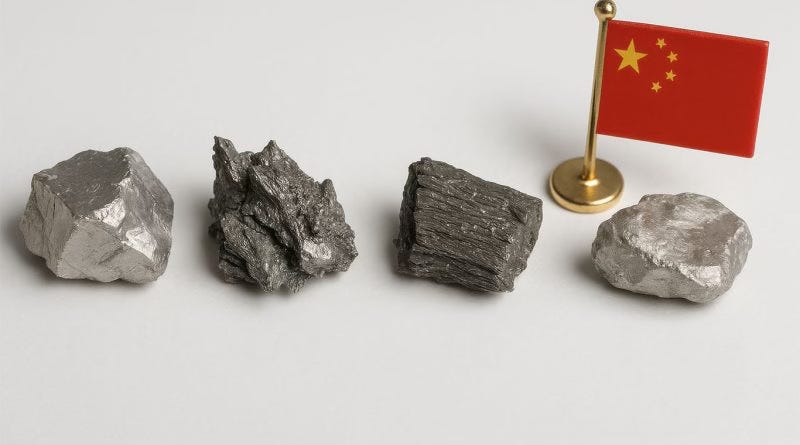
This is part 3 of 3 for breakdown of strategies to navigate China’s rare earth elements (REEs) export controls. Read parts 1 and 2 here:


Last but not least, let’s look at “buyback schemes”.
Part 3: Buyback Programs
Buyback programs are the enabler reuse and recycle, we already covered in part-2 of this series. Putting in place these programs encourages customers to return equipment. Some drone re-sellers already offer trade-in and buyback programs.
For example, some drone resellers like RMUS offer a trade-in through their “Fleet Renewal” program paying users hundreds of dollars for old drones like DJI Phantom or Mavic. These programs both upgrade the user’s equipment and reclaim the old parts for the company. Manufacturers and component providers can work with companies like RMUS to implement buyback programs.
Overall, depending on where you are in the value chain, consider these steps:
#1 Trade-In Incentives
Offer discounts or credit when customers return old drones. This might be a direct cash rebate, a discount on next-gen models, or additional service contracts. For instance, a police department upgrading a drone fleet could get $500 credit per old unit turned in. Even if the credit is smaller than retail value, the program can be used to secure the rare-earth components by working with the upstream supply chain.
#2 Lease and Refurb Programs
Instead of one-way sales, lease drones for a service fee. When the lease term ends, the company gets the equipment back automatically for redeployment or recycling — similar in some ways to car leasing. Defence and enterprise drone programs often have maintenance and upgrade cycles built in; formalising this ensures no stray units clog the aftermarket.
#3 Warranties and Bulk Buys
Offer premium maintenance or upgrade plans that include equipment refreshes. If a customer is paying for a multi-year support contract, part of that fee could cover systematic hardware turnover. This way, the manufacturer recovers expensive components directly and in bulk.
These buyback loops create a steady feedstock for the reuse and recycling strategies in part-2. Collecting used parts internally is far more reliable than hoping to scavenge them later. It also gives companies more control over pricing: by recovering magnets and oxides themselves, they offset market volatility. In effect, the buyer’s old drone becomes a deposit.
Together, these strategies form a comprehensive approach: diversifying the supply chain tackles the problem at the source; reusing and recycling extends the material’s and component’s value; and buyback programs ensure nothing falls through the cracks. For drone designers and manufacturers, each tactic reinforces the others.
These all require the resellers and distributors, OEMs, component suppliers, and the upstream supply chain working together. The result of these is a stronger, more diversified, and a more sustainable supply chain. Regardless of the politics and China’s REE dominance, this is something the drone industry can benefit from.
The Headlines
Defence and Security
Ukraine and Russia are increasingly using fiber-optic drones. Furthermore, Ukrainian drones are now equipped with metal "cope cages" to protect against enemy interceptors. Last week, Ukrainian drones hit a Russian Black Sea gas platform, destroying a radar system and depots.
China is preparing its massive Jiu Tian SS-UAV drone mothership—capable of deploying 100 drones over 4,350 miles.
To boost self-reliance, Taiwan is investing $212 million in domestic drone production and AI-powered systems free of Chinese components, while exploring European partnerships.
Raytheon has opened a facility in Abu Dhabi to locally assemble Coyote counter-drone systems.
Estonia’s Meridein Group to launch a facility by 2026 to produce up to 2,000 drones daily.
DARPA’s POWER program set a new record by wirelessly transmitting 800+ watts of laser power over 8.6 km.
General Atomics has begun ground tests for its YFQ-42A drone, which will fly alongside U.S. Air Force jets as part of its next-gen autonomous combat aircraft program.
The U.S. Air Force is developing air-launched "fighter drones" to assist manned jets in missions like surveillance and strikes, expanding the CCA program’s capabilities.
Mitsubishi and Yamaha tested a hybrid UAV carrying 200 kg over 200 km, designed to serve hard-to-reach regions and debuting at Japan Drone 2025.
Rohde & Schwarz’s ARDRONIS Wi-Fi system can identify, track, and neutralize Wi-Fi-controlled drones without disrupting other signals, ideal for use in sensitive public areas.
Commercial
The UK CAA has funded the nation’s first live demo of overlapping drone traffic systems, aiming to modernise airspace governance for commercial and emergency drone use.
DoorDash and Wing launched drone food delivery in Charlotte, NC, offering 15-minute deliveries from restaurants within a 4-mile radius.
Amazon is now FAA approved to deliver lithium battery products by drone in Arizona and Texas.
Policy and Regulations
The Defense Innovation Unit (DIU) has revamped its Blue UAS program with a two-tier system to streamline the approval and deployment of secure, high-performance military drones.
MFE and Skydio received FAA approval for fully remote drone inspections using autonomous drones, setting a new standard for industrial operations.
Partnerships
Anduril and Archer are developing a hybrid eVTOL cargo aircraft for rapid, cost-effective deployment in military and civilian missions across the UK.
High Lander and INVOLI have teamed up to merge drone traffic management with real-time manned aircraft surveillance for safer BVLOS drone operations.
Aloft and uAvionix are integrating ADS-B tracking and optical detection into a unified platform to enhance BVLOS drone visibility and airspace safety.
Sagetech and MatrixSpace are building autonomous “detect and avoid” systems for drones using AI radar and certified safety tech to improve BVLOS safety in national airspace.
Money Matters
Contracts
DroneShield: $1M+ contract secured with an Australian law enforcement agency to deliver AI-powered counter-drone tools like the DroneGun Mk4.
Investment and M&A
John Deere has acquired Sentera to integrate its drone imaging and analytics tech into the Operations Center, enhancing precision agriculture and data-driven farming.
Recommended Reading this Week
CCA sticker shock: Coming soon to a congressional hearing near you?
What if our assumptions about a war with China are wrong?
ABOUT THE AUTHOR
This newsletter is authored by Adit Shah, founder of Elantar, a UK-based boutique strategy consulting firm specialising in helping companies accelerate and de-risk their growth in aerospace, defence, and space sectors. For contact, please get in touch via LinkedIn.