

Welcome to this week’s Beyond Line of Sight!

Russia launched its military invasion of Ukraine on 24 Feb 2022. Last week marked three years since the invasion. Ukraine has gone from using modified DJI drones at the start of the war, to having a dynamic drone development and manufacturing ecosystem. Ukraine collectively manufactured 200,000 drones per month in Jan 2025. Many of these are kamikaze FPV anti-personnel and anti-armour drones.
Russia’s bread and butter loitering munition drone, Geran-2, is a variation of Iran’s Shahed-136. Geran-2 build rate is believed to be around 2,000 per month. Geran-2 has a 2,000km range, can carry a 40kg warhead, and costs roughly $35,000. More recent versions of Geran-2 have a lower range but can carry up to 90kg of munitions.
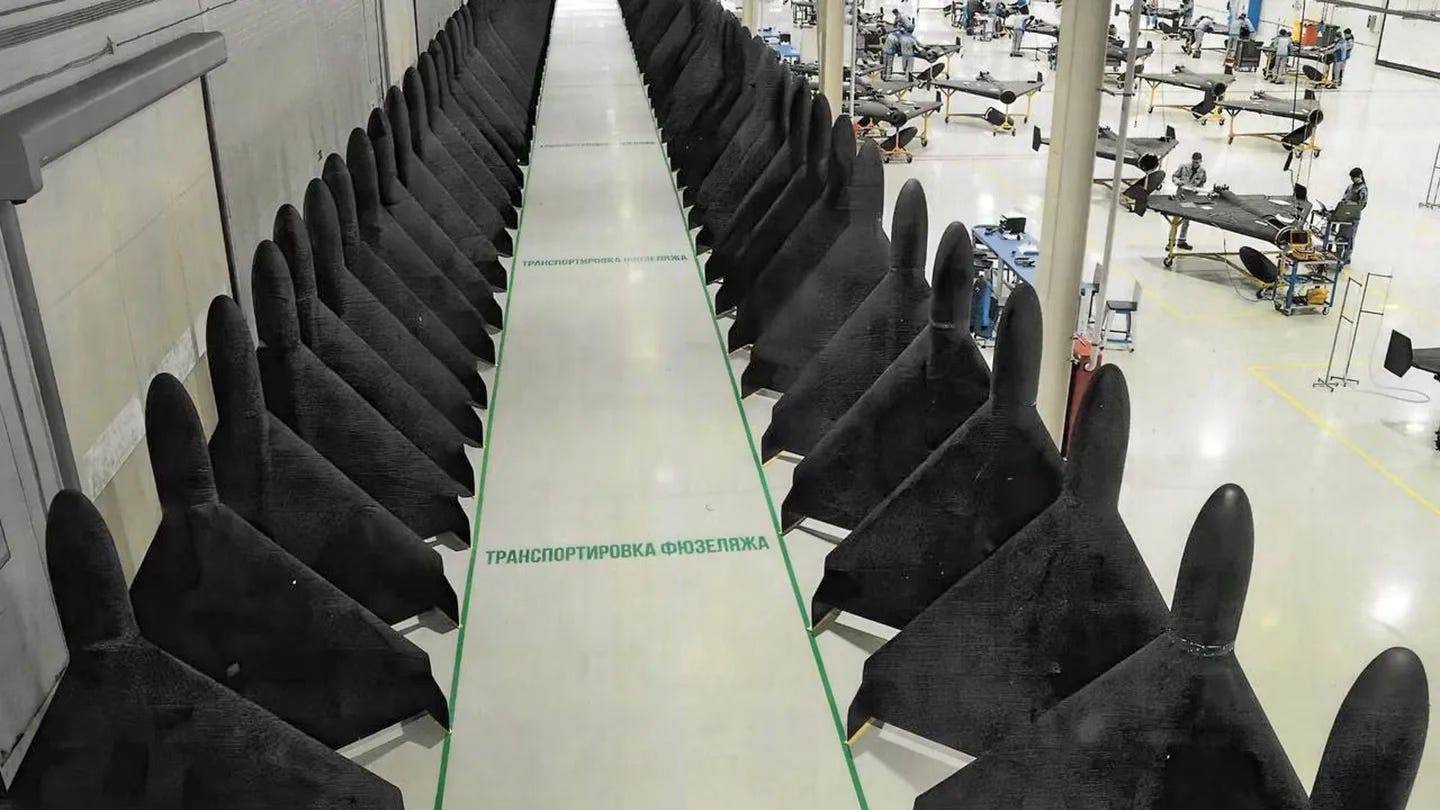
According to CSIS, the Geran-2 hit the target less than 10% of the time. Russia has also started using decoys, called Gerbera, that cost a third of the Geran-2. Having the decoys within their swarms allows Russia to overwhelm the Ukrainian air defences.
War Quants conducted an excellent analysis on Russia’s drone swarms. Here’s a chart taken from War Quants’ analysis showing the size of the Russian drone swarm.
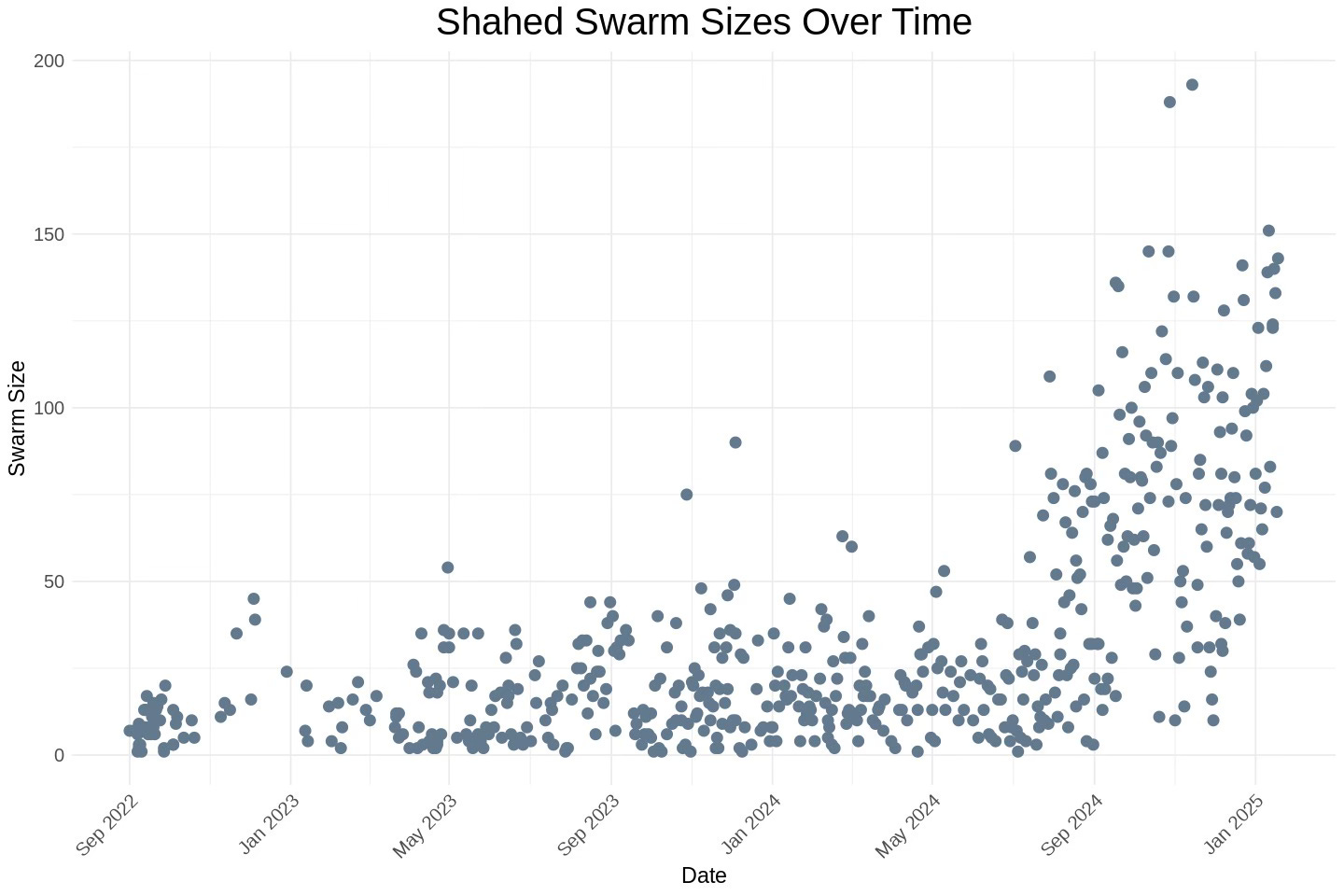
A Ukrainian air defence volunteer in this CNN article from Dec 2024 estimates that only about 20 to 30 out of a swarm of 150 drones have the warheads. This means up to 80% of drones are decoys. With the increase in size of Russian drone swarms, the ability to counter these is crucial.
RF jamming, missiles, interceptor drones, small arms, and many other counter-drone measures are deployed. Technology and tactics are evolving fast. Drones like Geran-2 are already somewhat ‘fire and forget’. While not truly autonomous, Russia is working on this.
In just 3 years, Russian Shahed /Geran-2 swarm sizes have gone from a few drones to nearly 200 drones. Russia also uses cheap decoy drones which can make up to 80% of a swarm.
There’s no single solution to this. A layered approach is required. Ukraine is already adapting to this quickly, but resource management is key. Resources (including money) are limited and hard to replace.
Capabilities such as the ability to predict which drones are decoys once detected can allow Ukraine to target their resources more effectively to countering these swarms. Combining counter-drone measures is more necessary than ever, and systems that can work with each other easily are highly valuable.
The Headlines
Defence and Security
Ukrainian drones struck Russia's Ryazan oil refinery, causing major fires and disruptions in its aviation fuel supply, marking the third such attack this year.
A European Parliament delegation visited Quantum Systems Ukraine to review its growing drone production, with leaders backing the use of frozen Russian assets to boost manufacturing in Ukraine and the EU.
GA-ASI successfully tested the MQ-9B SeaGuardian drone’s new anti-submarine warfare capabilities, using advanced sonobuoys to detect and track underwater targets as a cost-effective alternative to manned operations.
The Royal Navy’s 700X Naval Air Squadron deployed the Peregrine mini-helicopter drone during Middle East counter-narcotics missions, enhancing long-range surveillance on ships like HMS Lancaster.
Lockheed Martin introduced a scalable counter-drone system that integrates AI-powered tracking with an open-architecture design, allowing flexible defence against single drones and swarms.
Commercial
DJI launched Dock 3, a versatile "drone-in-a-box" system, supports Matrice 4D and 4TD drones, operates in extreme temperatures, and can be vehicle-mounted for rapid deployment.
A Heron TP reconnaissance drone completed its first long-distance flight across Europe’s busy airspace, showcasing growing unmanned aerial capabilities for military and civilian use.
Partnerships
HIEN Aero Technologies is integrating ePropelled’s lightweight "Starter Generator" into its DRAGON gas turbine, improving hybrid UAV performance for logistics, disaster prevention, and surveillance.
Cummings Aerospace and ATRX are developing supersonic and hypersonic drones by combining ATRX’s air turbo rocket engine with the Hellhound UAS to enhance military and spaceplane capabilities.
Taiwanese drone companies have partnered with firms in Czechia and Poland to expand industry development and access the European market through joint production and technology agreements.
Mahindra Group and Anduril Industries are collaborating on AI-powered counter-drone and autonomous maritime systems to strengthen defense, surveillance, and command-and-control capabilities.
Money Matters
Contracts
Skydio and Paukner — awarded €18 million contract from Spain’s Ministry of Defence to enhance military intelligence and surveillance capabilities.
PteroDynamics — U.S. Navy expanded its contract to develop the P5 Transwing® VTOL drone.
Teledyne FLIR Defense — secured a $15 million contract to provide Black Hornet 4 nano-drones to the German Army.
Unusual Machines — contract to supply NDAA-compliant motors to Red Cat Holdings, supporting U.S. government and commercial drone platforms.
Aurora Flight Sciences — awarded a $24.9 million DARPA contract modification for the Liberty Lifter program.
Investment and M&A
Boeing plans to sell its subsidiary Insitu, known for long-range military drones, as part of a strategy to refocus on core commercial and defense operations. Boeing acquired Insitu in 2008 and is valued at roughly $500 million.
Recommended Reading this week
Trump’s Navy secretary nominee endorses joint collaboration with Air Force on drone enablers
ABOUT THE AUTHOR
This newsletter is authored by Adit Shah, a UK-based business and strategy consultant specialising in aerospace, defense, and space sectors. For contact, please get in touch via LinkedIn.
Colonel Vadym Sukharevskyi, head of Ukraine's Unmanned Systems Forces, has expressed concerns over NATO's preparedness for modern drone warfare. He emphasized that no NATO army is currently equipped to counter the extensive use of drones, highlighting the economic advantages drones offer due to their relatively low production costs compared to traditional weaponry.
Ukraine has proactively integrated advanced technologies in response to the evolving battlefield dynamics. The nation is leveraging artificial intelligence, deploying ground drones, and testing laser systems to counter Russian unmanned aerial vehicles. This shift underscores the importance of technological adaptation in modern military strategies.
The conflict has also spurred Ukraine to develop cost-effective solutions, such as producing kamikaze drones priced between $300 and $1,000. These drones have proven effective in targeting armoured vehicles and tanks, showcasing the potential of affordable technology in modern warfare.
These developments serve as a wake-up call for NATO members, emphasizing the need to adapt to unconventional tactics and invest in counter-drone measures to maintain strategic advantages in contemporary conflicts.