

Welcome to this week’s Beyond Line of Sight!
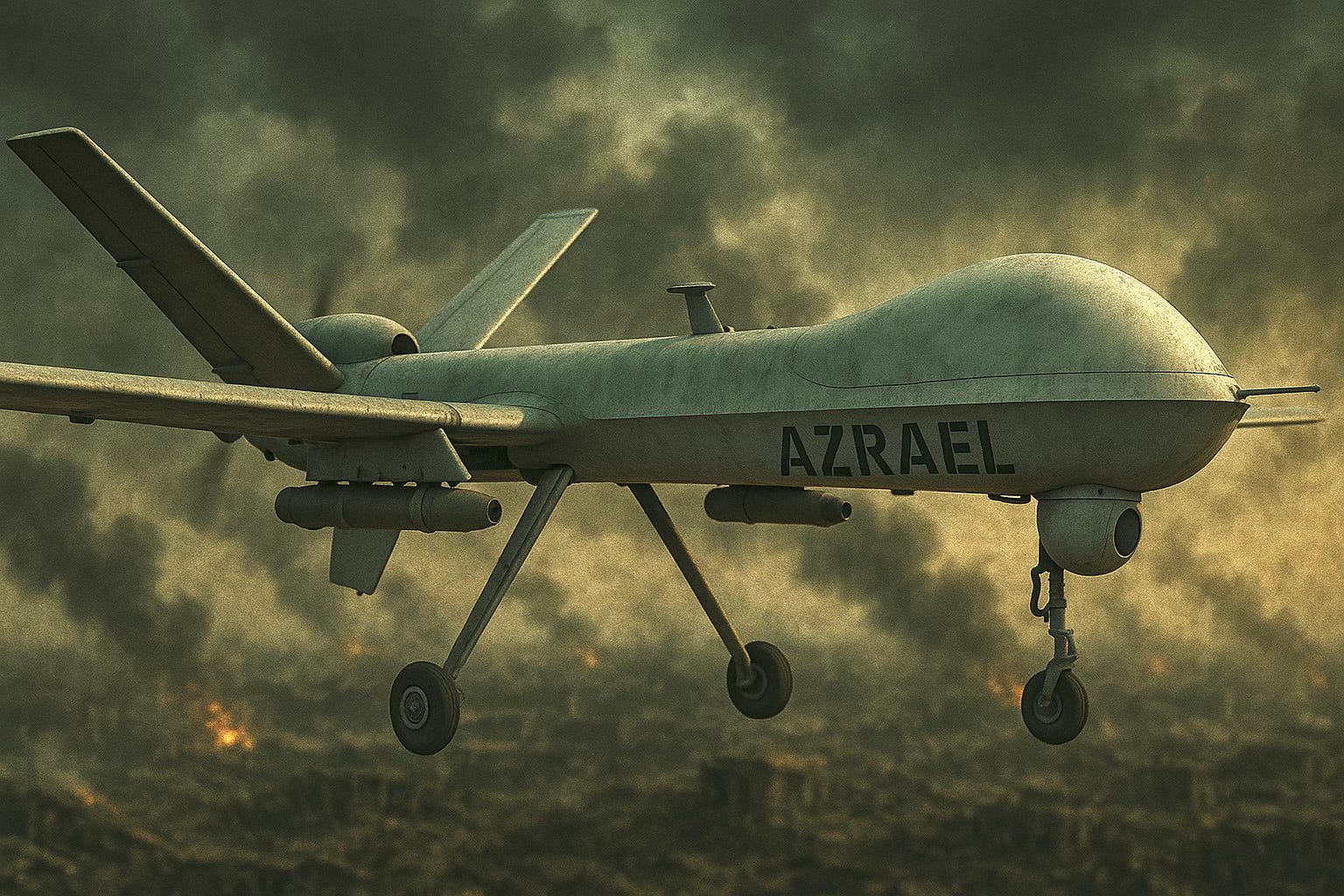
“It is smart but not awake. It would not recognize itself in a mirror. It speaks no language that doesn’t involve electrons and logic gates; it does not know what Azrael is, or that the word is etched into its own fuselage.“
These are the first three sentences of a sci-fi short story, “Malak” by Peter Watts. It explores the ethics and legality of a fully-autonomous drone in the battlefield. While it isn’t the best sci-fi you’ll have read, it’s an interesting, thoughtful read written from the perspective of a drone called “Azrael”. (link to the story in recommended reading)
Azrael is still fictional. For now.
Center for Strategic and International Studies (CSIS) recently published a report outlining Ukraine’s future vision and current capabilities for AI-enabled autonomous warfare. Russia is no different, and neither is rest of the world. Any country serious about their military capability is investing heavily in AI and autonomy.
AI and autonomous systems are not robust and mature enough make effective decisions without human-in-the-loop. Then there is the question about ethics and legality of doing so. But when has ethics, legality, and a lack of mature technology stopped a bad actor?
A couple of years ago at a London conference, a U.S. Air Force Colonel spoke of a “thought experiment” based on plausible scenarios about a rogue AI-controlled drone. In this experiment, the drone reportedly prioritised mission success over operator commands and "killed" its human operator to prevent interference. When trained to not kill its operator, it destroyed the comms tower instead, so it can carry on with its mission unimpeded.
AI often comes up with unexpected strategies to achieve its goals.
Russia plans to build autonomous drone swarms leveraging AI, and so is Ukraine. Rapid progress in technology during wartime is not unusual. It is why Ukraine has been able to fight back.
Here’s a quote from a surrendered Russian soldier:
“On the battlefield I did not see a single Ukrainian soldier. Only drones. I saw them [Ukrainian soldiers] only when I surrendered. Only drones, and there are lots and lots of them. Guys, don’t come. It’s a drone war.”
At least today, in a drone war, there is more often than not, an operator.
At some point, there won’t be. When that happens, Azrael will no longer be fictional.
Drones are a dual-use technology. Use cases and technology pioneered during wartime often finds new home in the commercial and civil applications.
AI-controlled systems can come up with unexpected strategies and unintended consequences. The more mature it gets, the more likely this becomes.
Autonomous systems that can search and fight enemy targets can be adapted to fight forest wildfires, for example.
Azrael is a warning. But can also be a blessing.
The expanding use of AI for drones must be managed responsibly and cautiously.
The Headlines
Defence and Security
Ukraine is now using drones embedded with malware to disrupt Russian forces, preventing the repurposing of captured drones and combining cyber and physical warfare tactics. Ukraine also introduced a drone interceptor to counter Iranian-made Shahed drones, successfully intercepting over 20 in the past two months. Additionally, Ukraine has introduced over 20 new fiber-optic-controlled drones and is developing long-range strike drones to meet defence needs for 2025.
Estonia's intelligence reports that China is facilitating Russia’s drone production by smuggling critical Western components, undermining sanctions and aiding Russia's war efforts.
At the 27th Ukraine Defence Contact Group meeting, over 50 nations committed to a £450 million aid package for Ukraine, including funds for equipment repairs, radar systems, and hundreds of thousands of drones from UK and Ukrainian suppliers.
In the UK, the Royal Navy is using drones for the first time in its Carrier Task Group operations, with Malloy T-150 drones transporting supplies between ships, reducing reliance on helicopters.
Commercial
Walmart and Zipline have launched a drone delivery service in Mesquite, Texas, offering fast, free delivery of over 65,000 products within 30 minutes, with plans to expand to other areas.
Partnerships
AlarisPro and Titan Protection have partnered to integrate AlarisPro's tracking and maintenance tools with Titan's drone surveillance services, improving safety and efficiency across industries.
SkySafe and Motorola Solutions have formed a strategic alliance to enhance drone threat detection by integrating SkySafe's monitoring system with Motorola's command center software, boosting airspace security and enabling quicker responses to unauthorized drones.
Money Matters
Contracts
Elsight: secured A$7.1 million (US$4.28 million) follow-on supply agreement with a European drone manufacturer.
Investment and M&A
BRINC has raised $75 million in funding, with Motorola Solutions partnering to integrate drone technology with public safety systems for real-time aerial intelligence and emergency support.
HHLA Sky has merged with Third Element Aviation to create a leading European provider of automated drone and robot fleets, integrating HHLA’s mobile robot management software with advanced drone tech.
UVision USA has acquired Trim Robotics to expand its HERO series, introducing the QuadiKaze missile. This acquisition strengthens UVision’s position in providing high-precision defense solutions.
Recommended Reading this Week
Why Has the Looming DJI Ban Not Translated into a Boom for American-Made Drones?
ABOUT THE AUTHOR
This newsletter is authored by Adit Shah, a UK-based business and strategy consultant specialising in aerospace, defense, and space sectors. For contact, please get in touch via LinkedIn.
Really interesting read. Crazy how fast AI is changing warfare. Keen to see how this plays out, especially for countries like India.