

Welcome to this week’s Beyond Line of Sight!
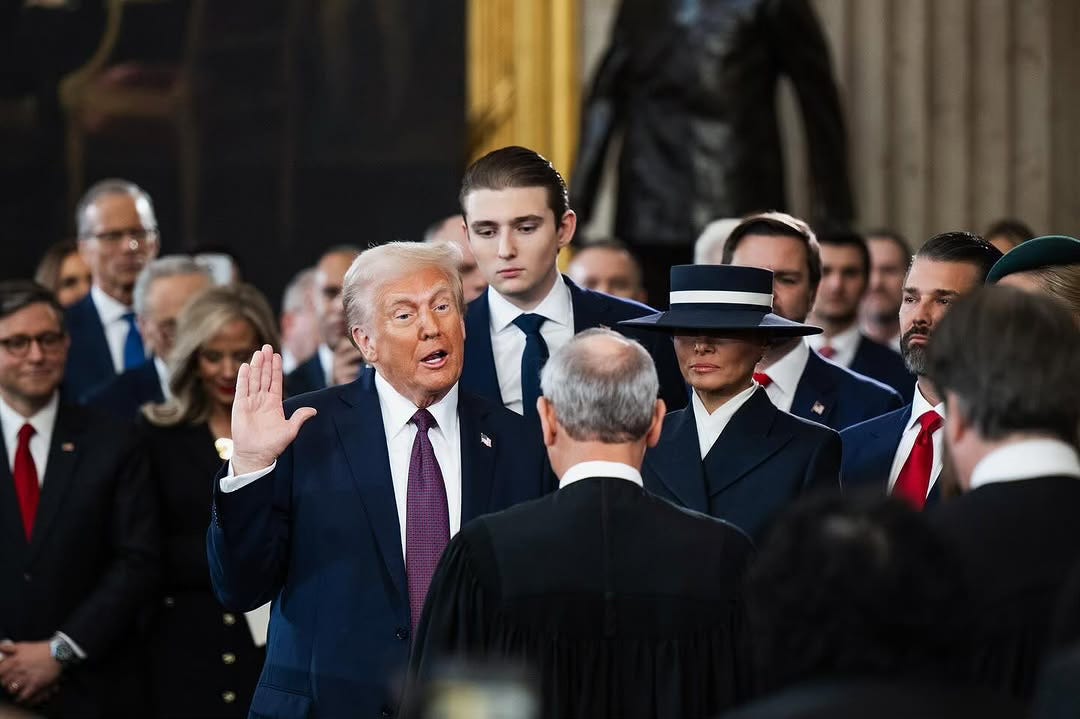
Last week, Trump completed 100 days of his second term as POTUS. A lot has happened in 100 days.
There are decades where nothing happens; and there are weeks where decades happen."
This quote, possibly misattributed to Lenin, seems to be true.
Let’s look at the major happenings from Trump’s first 100 days that have (or will have) an impact on the drone sector and around the globe.
Defence and Security Sector
Trump proposed a $1.01 trillion budget for defence and homeland security for FY2026 (a 13% increase) to “strengthen the safety, security, and sovereignty of the homeland; deter Chinese aggression in the Indo-Pacific; and revitalise America’s defence industrial base“. Congress backed this with a $150 billion reconciliation package that specifically funds new UAV programs – for example, it includes $1 billion to expand the industrial base for kamikaze (“loitering”) drones and additional hundreds of millions for AI-enabled UAS development and counter-drone systems.
Trump signed executive orders directing the Pentagon to deploy counter-UAS defences along the southern border, responding to reports of drug cartels using small drones for surveillance and attacks. Trump administration even considered (and faced backlash for) authorising armed drone strikes against Mexican drug gangs.
Commercial and Civil Sector
Transportation Secretary Sean Duffy announced in March 2025 that the FAA will soon propose new rules to allow expanded drone deliveries and services beyond visual line of sight (BVLOS). This aims to “give more authority and clarity” to companies testing delivery drones, saying clear rules are needed to keep U.S. industry competitive.
Security driven regulations continue to impact the U.S. drone market. The American Security Drone Act of 2023, during Biden administration, prohibits federal agencies from buying drones from “countries of concern,” effectively barring Chinese brands like DJI and Autel. A late-2024 mandate already threatens to ban DJI /Autel sales in the U.S. DJI has one year to “prove its innocence” but may get banned automatically if Trump does nothing.
Trade
The first 100 days also saw aggressive moves on trade and technology. Trump’s aggressive “Liberation Day” import tariffs, especially for Chinese goods. This may reach up to 245%. This has been, and will continue to disrupt the drone sector that still relies on Chinese drones, components, and raw materials. This has been covered previously in this newsletter:

On exports, Commerce’s Bureau of Industry and Security is poised to follow the Project 2025 blueprint: analysts note it calls for sharply tightening export controls (reclassifying China /Russia as “group D or E”, cutting license exceptions, lowering de minimis thresholds).
China’s recently announced stringent export controls on rare earth elements (REEs) as part of the escalating U.S.-China trade war has been having adverse effects on the drone sector directly and indirectly. This has also been covered recently:

Startups and Innovation
Despite the more restrictive trade backdrop, Trump’s known penchant for deregulation (the first term saw an 8:1 ratio of repealed to new regs) suggests a lighter touch on startups. Moreover, Congress has created new funding streams: the 2024 FAA Reauthorization Act established the first federal grants for drone infrastructure inspection programs and workforce training. Defense R&D programs are also funding autonomy and sensors – for example, the early FY2026 budget carves out over $190 million for AI-enabled drones ($145 million) and attritable drones ($50 million).
Startups in logistics, agriculture, emergency response and AI-powered surveillance are already attracting venture investment in anticipation of a boom. In short, while tariffs and bans squeeze some markets, the overall environment under Trump appears to reward U.S. drone companies who can fill the void (for example, domestic OEMs eager to replace Chinese drones).
Global Ripple Effects
Trying to rename the Gulf of Mexico to Gulf of America. Commenting about annexing Greenland and making Canada the 51st state. Launching “Trump 2028” merchandise. And more. Trump’s policies and comments go from horrific to hilarious and back again.
These have sent shockwaves across the globe, and the rest of the world has been scrambling to adjust as the world order is being overturned. Many European governments reacted to Trump’s “America First” stance by pledging higher defence spending and boosting home-grown UAV projects.
The UK, treading the fine line between the U.S. and Europe, is increasing its defence spending. (covered previously in the newsletter)

The EU launched a €150 billion defence fund with a potential to unlock up to €650 billion more — a total of €800 billion to European defence spending.


A non-significant portion of these budgets will go to drones and related areas.
Other U.S. allies (e.g. Japan, South Korea) are accelerating local UAV programs or eyeing drone imports from non-U.S. suppliers as trust frays. Experts warn that Trump’s tougher China policy and strained alliances could spur a drone “arms race”: if U.S. allies feel they cannot count on American drones, they will invest in indigenous systems, making drones a new axis of global competition.
The Headlines
Defence and Security
Latvia has delivered 1,500 more combat drones to Ukraine as part of its joint 12,000-drone commitment with the UK for early 2025.
The U.S. Congress has proposed a $150 billion defence bill with major drone investments, including $1 billion for attack UAS production and $1.1 billion for small UAS development.
The RAF has unveiled StormShroud, an autonomous drone built on the Tekever AR3 to jam enemy radars and shield F-35Bs and Typhoons using BriteStorm EW systems.
The Royal Navy has completed Banshee jet drone trials, using 400 mph uncrewed jets to simulate threats and strengthen air defense training.
The UK MoD has introduced a 600 kg “super heavy-lift” drone by ISS Aerospace, capable of autonomously delivering 250 kg of cargo to frontlines and ships.
TEKEVER will invest £400M in the UK over five years through its OVERMATCH initiative, advancing autonomy, EW, and the StormShroud program with 1,000 new jobs.
NATO must urgently adapt its drone defense strategies, says Maj. Gen. Adrian Ciolponea, warning that drone swarms—not single drones—pose serious military risks.
Airbus’ solar-powered Zephyr UAV set a new world record with a 67-day stratospheric flight, showing the promise of high-altitude platforms for persistent surveillance.
The U.S. Air Force has begun testing autonomous YFQ-42A and YFQ-44A drones under its CCA program, preparing for scalable human-machine operations.
General Atomics has delivered an MQ-9A Block 5 ER drone to the U.S. Marine Corps, expanding long-endurance surveillance capabilities.
AEVEX Aerospace’s Atlas Group II drone will be tested by U.S. Army units in a demo focused on launched effects for frontline support missions.
Anduril has launched Pulsar-L, a 25-pound EW system that detects and disrupts drones at the tactical edge, with plans to scale production to thousands annually.
Commercial
Silicon Valley’s SiFly has debuted long-range drones like the Q12 and Q250, offering helicopter-like endurance for emergency response and industrial tasks.
Partnerships
Airbus U.S. and Shield AI partner to equip the MQ-72C drone helicopter with Hivemind autonomy for autonomous logistics under the Marine Corps’ ALC program.
Altitude Angel and AirHub are partnering to bring unified airspace management to Europe, integrating real-time data and compliance into drone operations.
Baykar and Leonardo have formed a strategic UAV partnership to co-develop systems in Italy, deepening Türkiye-Italy defense ties and targeting Europe’s drone market.
Money Matters
Contracts
Near Earth Autonomy x Honeywell: $15 million contract awarded by the U.S. Army to upgrade Black Hawks with autonomous tech to enable pilotless supply missions in dangerous zones.
Investment and M&A
Piasecki Aircraft has acquired Kaman’s KARGO UAV program and plans to fast-track development of the 1,400-pound-capable drone for military cargo by 2026.
MBDA has invested in UK-based Hybrid Drones to co-develop the Hydra 400, a heavy-lift UAV designed for cargo, casualty evac, and weapon integration.
Recommended Reading This Week
Silicon Valley’s Military Drone Companies Have A Serious ‘Made In China’ Problem
ABOUT THE AUTHOR
This newsletter is authored by Adit Shah, a UK-based business and strategy consultant specialising in aerospace, defense, and space sectors. For contact, please get in touch via LinkedIn.