

Welcome to this week’s Beyond Line of Sight!
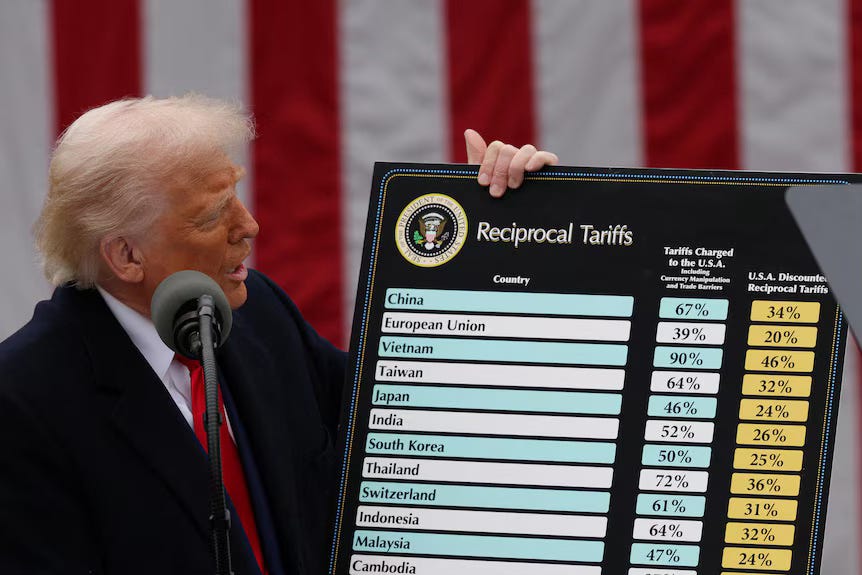
On Wednesday last week (2nd April), Trump unveiled a sweeping two-tier tariff system— a 10% baseline tariff on all imports (except from Canada and Mexico) coupled with steep, country-specific reciprocal tariffs on a large majority of its trading partners. While this is aimed at curbing trade deficits and re-industrialising the U.S., applying blanket tariffs like Trump has will have a massive impact on the drone industry.
What does this mean for the drone industry?
The U.S. is one of the top exporters as well as importer of drones globally. Parts of the U.S. drone supply chain still depend on importing components such as batteries, motors, semi-conductors, etc. In the short term at the least, this means chaos with global impacts.
Businesses globally will have to navigate through two huge challenges.
Challenge #1: Navigate through a potential global trade war
A global trade war may be underway (soon). As Europeans prepare a unified response while expressing dismay, China responded by placing export controls on rare earth metals for all countries (not just the U.S.).
China currently controls over 69% of global rare earth production and processes around 90% of the world’s rare earth metals. Rare earth metals are used for electric motor magnets, battery alloys, catalysts, etc.
Challenge #2: Navigate through a potential global recession
JP Morgan sees a 60% chance of a global recession before year end, with other banks mirroring similar sentiments. This means, less available capital for growth, lower profits, reduced demand (especially in non-defence applications).
In broad strokes, this means: higher material and component costs, disrupted supply chains, and lower growth.
The Takeaways
So what should business leaders do? There is no one answer fits all. Some will be impacted more than others, but at least one of the following points will be applicable to most businesses in the drone industry.
Go where the money is. Consider defence and dual/use applications. Defence spending has been (and will be for the next few years) increasing and will likely remain high, albeit at a time of high fiscal pressures.
Design more resilient supply chains. This is an opportunity to renegotiate contracts with suppliers, dual source components, on-shore capability, and work with more local suppliers.
Focus on survival at the expense of growth if you must. Slow growth is still growth and capital is becoming expensive. Wait out the storm and survive.
The Headlines
Defence and Security
Ukraine-Russia war continues. The Netherlands has fast-tracked a €500 million ($541 million) drone package to Ukraine under a broader €2 billion aid plan. Sweden is contributing 40 million kronor ($3.8 million) to strengthen Ukraine’s drone capabilities and has matched that amount for demining efforts.
Turkey’s Baykar is training Ukrainian personnel on Bayraktar TB2 drones, reinforcing Ukraine’s defenses while deepening strategic ties.
Russia is pairing its stealthy Okhotnik-B drone with the Su-57 fighter jet to enhance combat missions through manned-unmanned teaming and reduce risks to pilots.
HMS Dauntless intercepted drone swarms during Exercise Sharpshooter, proving the Royal Navy's readiness for future threats ahead of its Indo-Pacific deployment.
Mayman Aerospace completed the first fully autonomous flight of its RAZOR P100 VTOL aircraft.
Israel’s Rafael successfully tested its TYPHOON 30-mm anti-drone system.
Bluelight
Flock Safety has linked its Drone as First Responder (DFR) system with Flock911, allowing drones to launch as soon as a 911 call comes in—sometimes arriving on scene in just 86 seconds.
In the U.S., Georgia’s Dunwoody Police have deployed drones from City Hall’s rooftop to respond to emergencies in about 90 seconds, and California’s Oceanside Police will soon launch a similar drone program to cut response times to just 70 seconds.
Legal and Politics
China's Ministry of Commerce added 11 U.S. drone companies to its Unreliable Entity List.
Partnerships
UK’s Dstl and Australia’s DST Group are teaming up to develop adaptable, cost-effective weapons by combining the UK’s Modular Weapons Testbed with Australia’s SHARKTOOTH program. Their joint effort focuses on modular tech like 3D-printed engines, low-cost sensors, and smarter guidance systems to boost defense interoperability.
Hanwha Aerospace and GA-ASI are partnering to co-develop cutting-edge unmanned aerial systems, blending expertise to push innovation in both military and civilian sectors.
Hoverfly and BlueHalo are enhancing counter-drone defense by integrating Titan-SV signal detection into Spectre tethered drones for 24/7, stealthy threat monitoring from above.
Terra Drone has signed an MOU with Aramco to advance drone, robotics, and AI tech in oil and gas, boosting local innovation and supporting Saudi Arabia’s Vision 2030.
Money Matters
Contracts
Viking Arms Ltd: a £256k contract from the UK Ministry of Defence for the rapid procurement of 180 First-Person View (FPV) drones.
Investment and M&A
Hamburg-based Beagle has raised €5 million in seed funding to expand its long-range drone services. Beagle already has flight approval for about 80% of EU airspace.
AeroVironment shareholders have approved the company’s acquisition of BlueHalo, with over 99% voting in favor to support its shift toward integrated, next-gen defense technologies. The deal is expected to close in May 2025, pending final approvals and conditions.
Recommended Reading this Week
Move fast, kill things: the tech startups trying to reinvent defence with Silicon Valley values
ABOUT THE AUTHOR
This newsletter is authored by Adit Shah, a UK-based business and strategy consultant specialising in aerospace, defense, and space sectors. For contact, please get in touch via LinkedIn.