

Welcome to this week’s Beyond Line of Sight!

Last week, the UK Government published its 2025 Strategy Defence Review (SDR) policy paper. It highlights why UK defence needs to transform in the increasingly volatile and uncertain world, the role of defence, how to fight, the allies and partners, and the capabilities with which it needs to fight.
The report makes 62 recommendations, all of which have been accepted by the government.
There is a clear (unsurprising) focus on uncrewed and autonomous systems and a recognition that they are redefining warfare.
Here are the key points from the SDR to pay attention to for the drone industry:
Shift towards greater use of autonomous systems and AI as an immediate priority for force transformation.
“exploit the parallel development of a common digital foundation, a protected Defence AI Investment Fund, and an initial operating capability for a new Defence Uncrewed Systems Centre established by February 2026.”
“Uncrewed and autonomous systems should be incorporated into the Integrated Force in high numbers over the next five years. They should be networked with crewed fifth- and sixth-generation assets as part of a ‘high-low’ mix of capabilities…“
Recognition of ‘Digital Integration' in developing a force dominated by AI, uncrewed, and autonomous systems. This means “Embracing open architectures and shared technical standards, from standardised drone hardware ports, to universal communications and AI protocols.“
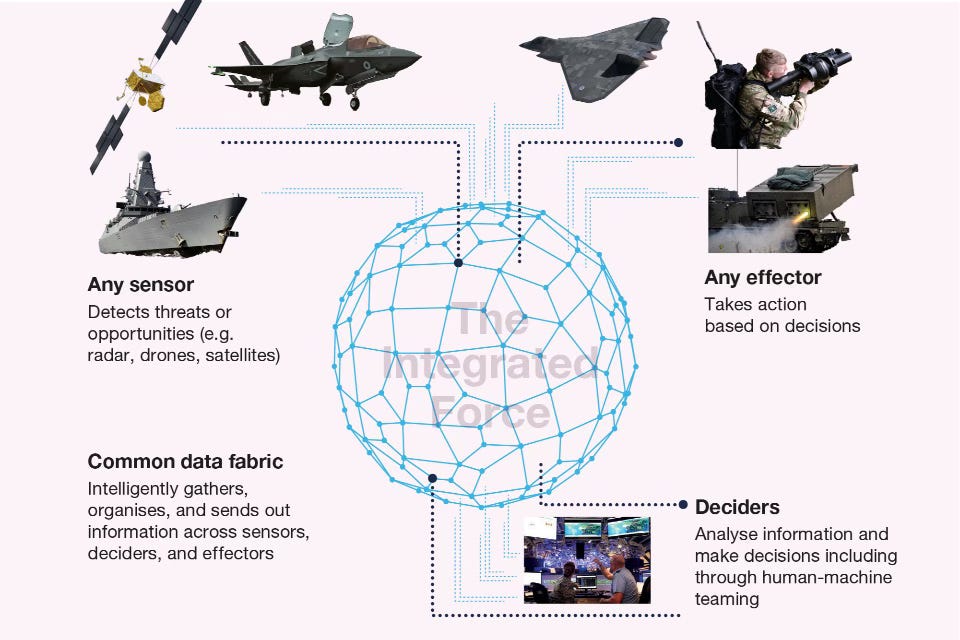
Create an ‘Integrated Force Model’ that “is more lethal than the sum of its parts and skilled in warfare in different forms.”. This would be through the digital targeting web informed by lessons from Ukraine. Here is an illustration of the ‘digital targeting web’ part of the Integrated Force Model from the report:
NAVY: “…the Royal Navy should engage with commercial partners—including private finance—and other Governments to rapidly deliver an integrated frigate force for anti-submarine warfare, comprising crewed, uncrewed, and autonomous platforms.“
ARMY: “Autonomous and uncrewed (land and aerial) systems are now an essential component of land warfare, integrated with core armoured platforms in a dynamic ‘high-low’ mix of capability. A ‘20-40-40’ mix is likely to be necessary: 20% crewed platforms to control 40% ‘reusable’ platforms (such as drones that survive repeated missions), and 40% ‘consumables’ such as rockets, shells, missiles, and ‘one-way effector’ drones. Investment in attack and surveillance drones should be prioritised, along with counter-drone systems.“
AIR FORCE: “To assure the future of UK combat air, investment in autonomous collaborative platforms (ACPs) should be considered alongside investment in FCAS and the Global Combat Air Programme. The ACPs must be designed to operate in collaboration with the fourth-, fifth- and future generations of combat aircraft and to operate from the UK aircraft carriers.“
Multi-domain integration: Project ASGARD to enhance the Army’s ability to find and destroy enemy targets. “It will fully integrate surveillance capabilities (including cyber and space) with firepower (such as artillery, long-range missiles, aircraft, and single-use uncrewed aerial systems) via the digital targeting web.”
Protecting Critical National Infrastructure (CNI) onshore, offshore, and in space: while the report recognises a more substantive body of work needs to be carried out on CNI, it is obvious that counter drone systems will be part of that solution for onshore and offshore CNI protection. Novel Directed Energy Weapons (DEW) have also been mentioned as a key focus area long with ‘EW jammers’ as part of ‘CyberEM’ (Cyber and ElectroMagnetic) domain.
Recommended Reading section at the end of this newsletter has some good commentary on thoughts on the 2025 UK SDR from various experts.
The Headlines
Defence and Security
On June 1, Ukraine launched Operation "Spiderweb," deploying 117 AI-powered drones to strike five Russian airbases, destroying dozens of bombers and dealing an estimated $7 billion in damage.
Ukraine is forming new air defence units and expanding electronic warfare training to counter massive drone attacks, including a recent record-breaking assault involving 472 drones.
Ukraine’s new AI-powered “Sky Sentinel” turret is already proving effective by automatically spotting and shooting down Shahed drones. In recent tests, a single unit downed six drones and costs just $150,000.
The UK pledged £350 million to deliver 100,000 drones to Ukraine by 2026, alongside artillery support and troop training funds.
Latvia announced that Turkey and Belgium will join the 20-member Drone Coalition, which has pledged €2.75 billion in 2025 to support Ukraine with technology and joint procurement.
Russia has introduced a national drone curriculum for 8th and 9th graders, aiming to train one million operators by 2030 across more than 500 schools and 30 colleges.
Israel’s Iron Beam laser system became the world’s first operational high-energy laser weapon, effectively intercepting drones, rockets, and mortars in combat.
The Royal Navy successfully integrated a Puma drone with a crewed helicopter, marking a key advancement in hybrid maritime air operations.
France has deployed mobile micro-factories near the front lines to produce FPV drones on demand, boosting tactical flexibility and reducing supply chain reliance.
The U.S. Air Force has equipped F-15E jets with APKWS II rockets, enabling each aircraft to engage up to 50 drones per mission at significantly lower cost.
The UK announced a £5 billion investment in advanced drones and laser weapons, including plans to deploy the DragonFire laser on naval destroyers by 2027.
Bluelight
San Francisco is expanding citywide drone surveillance with a $9.4 million donation from Ripple’s co-founder.
Hong Kong police are using drones with loudspeakers and autonomous patrols to deter rural crime, raising questions about surveillance overreach.
Commercial
Walmart and Wing are expanding their drone delivery service to 100 stores in major U.S. cities, promising deliveries in under 19 minutes to millions of households.
Japanese researchers have developed a wireless energy beam that powers drones mid-flight without interfering with their onboard equipment, extending mission durations.
Portugal’s Marina de Lagos will become the first in the country to adopt Altitude Angel’s drone approval platform, enabling near-instant flight authorizations via Drone Assist and DroneSafetyMap.
Policy and Regulations
President Trump signed executive orders to fast-track U.S. drone innovation, strengthen airspace security, and reduce dependence on foreign technology. DJI has responded to these, expressing support for U.S. drone innovation and regulation improvements like Remote ID and BVLOS capabilities.
Congresswoman Elise Stefanik reintroduced the DFR Act, proposing tariffs on Chinese drones and funding for U.S.-made alternatives to secure critical infrastructure.
Partnerships
Nokia is leading an EU initiative with partners like Nvidia to develop autonomous drones and robots that protect vital infrastructure across land, sea, and air.
GE Aerospace and Kratos are partnering on affordable jet engines for next-gen unmanned aircraft.
Alpha Unmanned Systems and Airbus Helicopters España are teaming up to integrate tactical drones with manned missions.
Money Matters
Contracts
Terra Industries (Nigeria): won a $1.2 million deal to provide aerial security for two hydropower plants using autonomous drones and surveillance towers.
Xplorate (Australia): secured a contract (amount undisclosed) to inspect long-range gas pipelines using BVLOS drone operations, integrating AI to predict maintenance needs and extend infrastructure lifespan.
Vigilant Aerospace Systems (US): selected by the U.S. Air Force under the $46B EWAAC program to supply its FlightHorizon detect-and-avoid software for safer, autonomous drone operations.
SmartShooter (Israel): secured a $13 million U.S. Army contract to deliver AI-powered SMASH 2000L rifle-mounted systems for enhanced drone and ground threat targeting.
Picogrid (US): received a $1.1 million U.S. Army contract to deploy its Legion platform, which fuses data from legacy and modern military systems into battlefield tools like TAK.
General Atomics (US): won an $8.2 million U.S. Air Force contract to arm Spain’s MQ-9A Reaper drones under the Foreign Military Sales program, and a $34.9 million Navy contract to supply spare parts for MQ-9 Reapers and ground control stations, supporting U.S. Marine unmanned operations.
Investment and M&A
Drone detection startup Hidden Level raised $100 million to expand production of its passive radar tech, which detects both traditional and stealth drones for military and public safety use.
Recommended Reading this Week
Some thoughts on the UK 2025 Strategic Defence Review from elsewhere on the net:
Strategic Defence Review signals change, but without troops, nukes or funds, it's just words
War plan or wish list – The UK Strategic Defence Review (audio podcast)
ABOUT THE AUTHOR
This newsletter is authored by Adit Shah, founder of Elantar, a UK-based boutique strategy consulting firm specialising in helping companies accelerate and de-risk their growth in aerospace, defence, and space sectors. For contact, please get in touch via LinkedIn.