

Welcome to 2026.
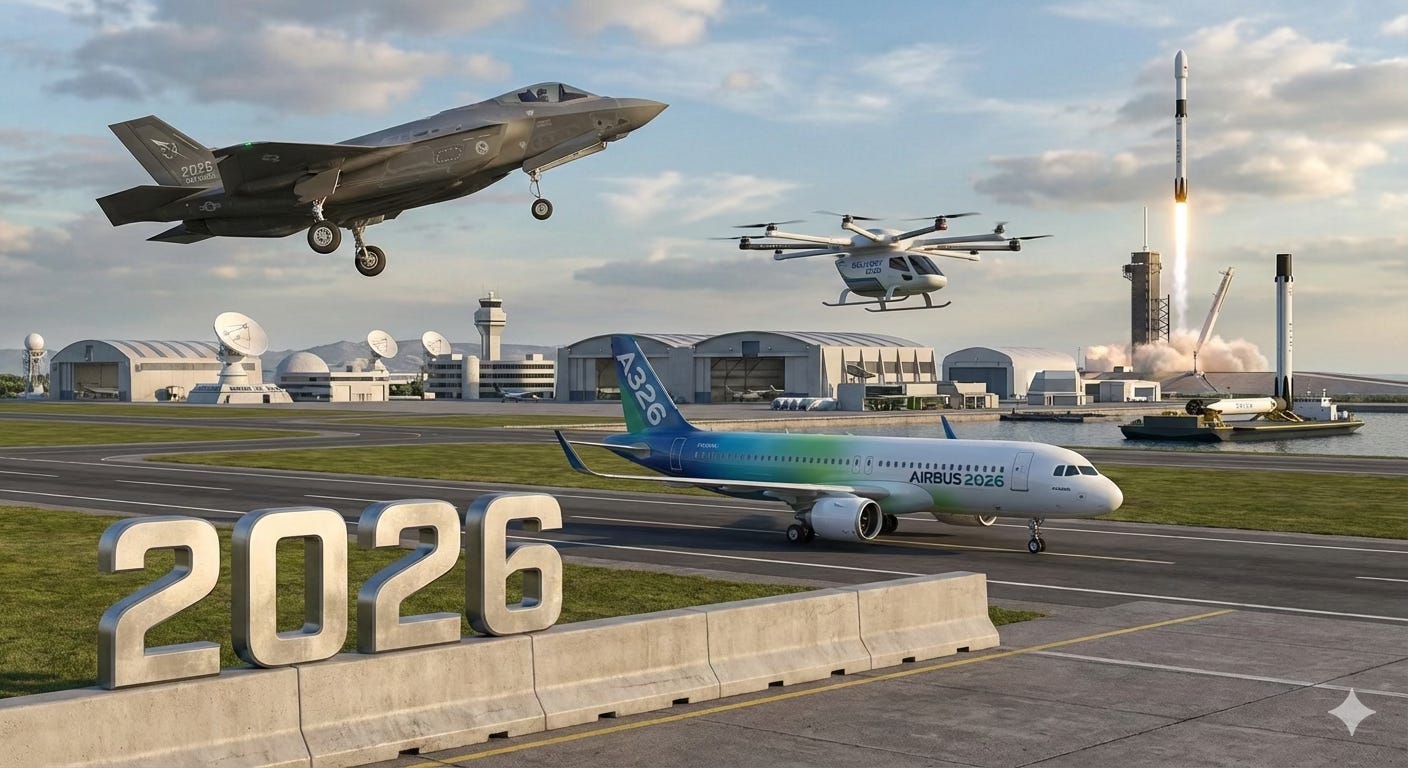
Here’s an AI-generated image of fictional modern aerospace and space vehicles:
This post sets the scene for what Beyond Line of Sight (BLOS) is focused on this year and why it matters.
How Beyond Line of Sight Has Evolved
Beyond Line of Sight started in Sep 2024 as a simple aggregation of news in the drone sector. The problem was information overload and signal scarcity, something that still persists today.
As my work expanded across aerospace, defence, and space, the briefing expanded with it. But the more meaningful shift wasn’t coverage, it was focus.
Across dozens of organisations globally, from start-ups and scale-ups to tiered suppliers and primes, the same pattern keeps appearing. Companies operating in similar markets, facing similar demand, see very different growth outcomes.
The difference is rarely access to opportunity. It’s the organisation’s ability to identify and resolve growth constraints.
That pattern is pushing BLOS to evolve.
What This Briefing Focuses On Now
Aerospace, defence, and space companies are constantly launching new products, announcing partnerships, and winning contracts. From the outside, growth still looks like a sales problem:
Win more tenders. Hire more BD capacity. Expand into new markets.
Sometimes it is. But in practice, that’s rarely where growth breaks.
More often, constraints sit elsewhere:
Products that no longer fit how customers actually buy
Processes that can’t absorb scale, regulatory load, or programme complexity
People, incentives, and decision-making structures misaligned with where the market is going next
Commercial commitments that quietly outpace delivery capability
These issues are usually invisible early on. By the time they surface, teams have often already doubled down on sales and expansion. Growth becomes noisy, expensive, and stressful, not because the opportunity isn’t real, but because the organisation isn’t ready for it.
BLOS now exists to make those constraints visible before they become crises.
Why This Briefing Exists in 2026
In 2026, demand is not the problem in aerospace, defence, and space.
Industrialisation pressure, delivery risk, capital discipline, organisational coherence, and commercial execution capacity are.
As these markets evolve, growth is increasingly constrained at the interfaces between sales and delivery, between ambition and execution, and between strategy and how work actually gets done.
The cost of misalignment is higher than it used to be. The margin for error is smaller.
This is where many growth narratives quietly break down and where leadership teams often have the least visibility.
That’s the gap this briefing exists to close.
What BLOS Is (and Is Not)
Beyond Line of Sight is not a monthly market update or a news digest.
It’s a growth readiness lens.
Each edition uses real signals from aerospace, defence, and space to help you:
spot trends that will stress internal capability
recognise readiness gaps before they constrain growth
pressure-test alignment across market, product, process, and people
Think of it as a short, regular prompt to step back from execution and ask: Are we actually set up to grow without breaking?
What’s Coming Next
Over the next two weeks, as a new year special, I’ll focus on two pieces.
First (Jan 12, 2026), I’ll revisit what I expected the drone industry to face in 2025, reviewing it against what actually happened, based on my post here:

Then (Jan 19, 2026), I’ll outline what I think 2026 will look like for aerospace, defence, and space more broadly.
Not as predictions for their own sake, but as indicators of where organisational constraints are likely to surface next.
If you haven’t subscribed yet, here’s your chance: